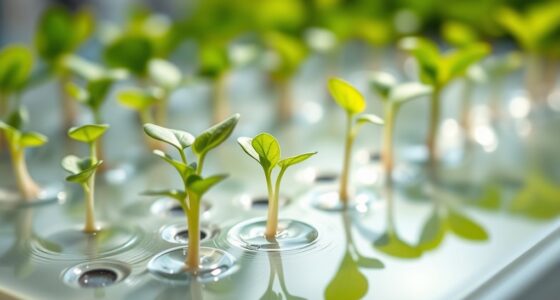
In NFT systems, nutrients flow as a thin film over roots in sloped channels, providing high oxygen exposure but making them sensitive to flow interruptions. DWC submerges roots directly in nutrient-rich water, with air pumped in to supply oxygen, offering a more stable environment and faster growth. While NFT prioritizes nutrient efficiency, DWC emphasizes consistent oxygenation and higher yields—if you want the full picture, there’s more to explore.
Key Takeaways
- NFT delivers nutrients via a thin, flowing film of water over roots, ensuring continuous but variable nutrient contact.
- DWC submerges roots directly in nutrient-rich, static water, allowing constant, stable nutrient and oxygen access.
- NFT relies on flow rate management; disruptions can cause nutrient deficiency or root drying.
- DWC uses aeration to oxygenate stagnant water, promoting stable oxygen levels and preventing stagnation.
- DWC generally provides more consistent nutrient delivery and faster growth compared to NFT’s flow-dependent system.

When choosing a hydroponic system for your garden, understanding the differences between Nutrient Film Technique (NFT) and Deep Water Culture (DWC) is essential. Both methods deliver nutrients differently, impacting plant health and growth rates. NFT operates by continuously flowing a thin film of nutrient-rich water over the roots, which are supported in a sloped channel. This setup ensures a constant supply of oxygen and nutrients, but it also requires careful management of flow rates to prevent root drying or oversaturation. DWC, on the other hand, submerges the roots directly in a nutrient solution, with an air pump maintaining oxygen levels. This creates a more stable environment where roots have constant access to nutrients and oxygen, often resulting in faster growth and higher yields. Additionally, DWC systems often utilize high-quality aeration, which enhances oxygen exchange and promotes healthier roots.
Understanding the aeroponics comparison can shed light on the differences in aeration effects among these systems. While aeroponics involves suspending roots in the air and misting them with nutrient solution, both NFT and DWC rely heavily on aeration to meet the plant’s oxygen needs. In NFT, the thin film of water encourages high oxygen exposure because roots are mostly exposed to air, but if the flow stops or decreases, oxygen levels can drop quickly, stressing plants. DWC’s aeration depends on bubbling air through the water, creating a saturated environment rich in dissolved oxygen. This method generally provides a more consistent oxygen supply, reducing the risk of root diseases caused by low oxygen levels.
The aeration effects in DWC are particularly notable because the constant bubbling not only supplies oxygen but also helps prevent stagnation and the buildup of pathogens. In contrast, NFT’s aeration relies on the film’s thinness and the exposure of roots, which, if disrupted, can limit oxygen availability. This makes DWC more resilient to fluctuations in system operation, but it also demands a reliable air pump. The choice between these systems often hinges on your priorities: NFT offers efficient nutrient use and less water, but it’s more sensitive to flow interruptions, while DWC provides a stable environment with robust aeration, promoting vigorous root growth.
Frequently Asked Questions
Which Hydroponic System Is More Suitable for Beginners?
If you’re a beginner, Deep Water Culture (DWC) is more suitable because it offers system scalability and is cost-effective. DWC is straightforward to set up and maintains, making it ideal for newcomers. You can easily expand your system as you gain experience. Its simplicity helps you learn the basics of hydroponics without high initial costs, giving you a reliable, manageable way to start growing plants successfully.
How Do Nutrient Concentrations Differ Between NFT and DWC?
Coincidentally, your focus on nutrient concentrations reveals the key differences in delivery efficiency between NFT and DWC systems. In NFT, nutrient concentration is typically lower and more precisely controlled, promoting steady growth. DWC systems often have higher nutrient concentrations due to their larger volume, allowing for more buffer and less frequent adjustments. This variation impacts how plants absorb nutrients, with DWC providing a more stable environment and NFT offering fine-tuned delivery.
What Are the Common Pests and Diseases in Each System?
In NFT systems, you often face pests like aphids and fungus gnats, while DWC setups may attract spider mites and root rot issues. To manage pests, practice regular pest management and monitor plants closely. For disease prevention, guarantee proper sanitation and maintain ideal water quality. In both systems, controlling humidity and airflow helps reduce mold and fungal problems, keeping your hydroponic garden healthy and productive.
Can NFT and DWC Be Combined for Better Yields?
Imagine merging two lush rivers into one vibrant stream—this is what system integration of NFT and DWC can do for your grow space. By combining these methods, you harness the strengths of both, creating a symphony of nutrient flow that boosts yield optimization. You’ll see healthier plants, faster growth, and better overall output, turning your setup into a powerhouse capable of producing bountiful harvests with enhanced efficiency.
How Do Energy Consumption and Maintenance Compare?
You’ll find that DWC systems generally consume more energy due to aeration needs, making them less energy-efficient than NFT setups. Maintenance tends to be easier with NFT because of its simpler, closed-loop design, which reduces cleaning and monitoring. DWC requires more regular attention to oxygen levels and water quality, increasing maintenance effort. Overall, if energy efficiency and ease of maintenance matter most, NFT often has the edge.
Conclusion
In choosing between nutrient film technique and deep water culture, consider your plants’ needs and system maintenance. For example, a small urban farm might find DWC easier for rapid growth, while NFT suits a high-volume, space-efficient setup. Both methods deliver nutrients effectively, but understanding their differences helps you optimize yields. Ultimately, selecting the right system depends on your goals, resources, and plant types, ensuring healthy growth and a successful harvest every time.