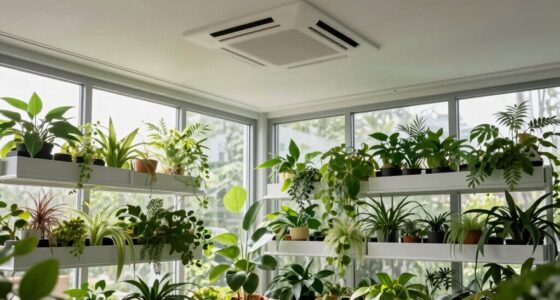
You’ll find that compact vertical farms work best when you simplify crop variety because it boosts efficiency and reduces operational complexity. Focusing on fewer, high-yield crops makes managing resources like lighting, watering, and pest control easier. It also helps maximize space and cut costs while maintaining consistent produce quality. Plus, a streamlined crop selection increases farm resilience to environmental changes. Keep exploring to discover how these strategies can help you succeed in urban agriculture.

Get garden gear delivered free — and shop member deals
- Fast, free delivery on millions of items
- Access to Prime Big Deal Days deals on October 6–7
- Prime Video, Amazon Music and more included
Key Takeaways
- Simplifying crop varieties enhances operational efficiency and reduces management complexity in compact vertical farms.
- Fewer crop types improve pest control strategies and promote ecological balance.
- Limited crop diversity allows precise resource allocation, lowering costs and waste.
- Focused cropping increases resilience against environmental fluctuations and supply inconsistencies.
- Streamlined crop selection supports sustainable practices and boosts overall farm productivity.
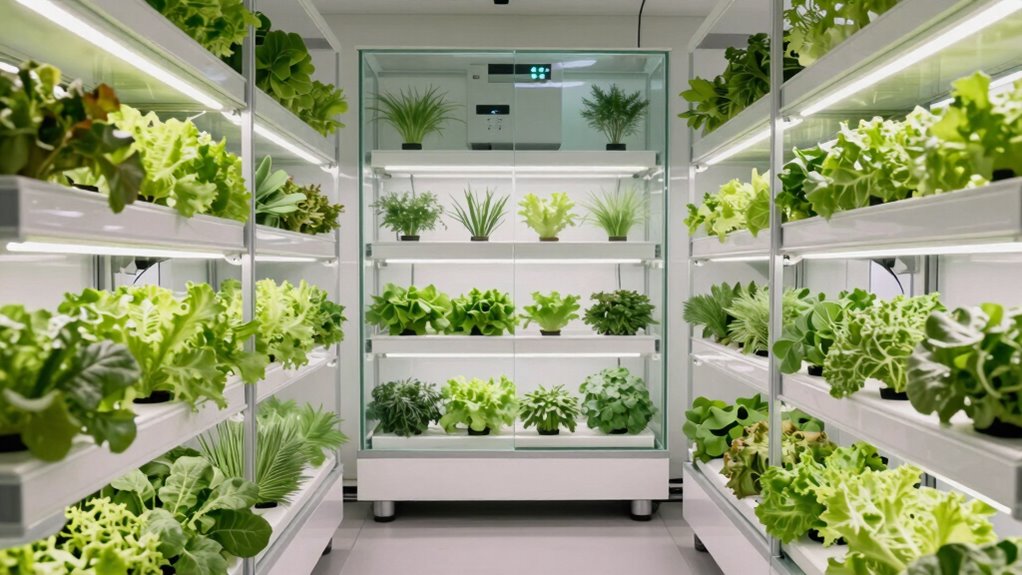
Vertical farms are revolutionizing agriculture by making crop variety more accessible and manageable. When you choose to operate a compact vertical farm, simplifying your crop selection becomes essential. The limited space means you can’t grow every crop you might want, so focusing on a few well-chosen varieties helps maximize productivity and efficiency. By doing so, you streamline your operations, reduce complexity, and make it easier to maintain consistent quality. This approach also supports urban sustainability, as vertical farms are often situated in cities where space is at a premium. Keeping your crop variety simple enables you to produce fresh, healthy food close to consumers, cutting down on transportation emissions and contributing to a greener, more sustainable urban environment.
Simplifying crop choices in vertical farms boosts efficiency, sustainability, and quality for urban agriculture success.
When you concentrate on a limited set of crops, pest management becomes more straightforward. Instead of dealing with multiple pest species across different plants, you can develop targeted strategies for the specific pests that affect your chosen crops. This reduces the need for broad-spectrum pesticides, which can harm beneficial insects and disrupt your farm’s ecological balance. With fewer crop varieties, you can implement integrated pest management techniques more effectively, monitoring pests closely and applying precise interventions. This approach not only keeps your plants healthier but also aligns with sustainable practices, minimizing chemical use and fostering a safer environment. Additionally, focusing on fewer crops allows for easier crop rotation planning, which helps prevent soil depletion and pest buildup in larger-scale systems.
Simplifying crop variety also benefits your resource management. You can optimize your lighting, watering, and nutrient delivery systems for the specific needs of your chosen crops. This precision helps reduce waste, lowers operational costs, and increases overall yield. In compact vertical farms, where every inch counts, tailoring your inputs to a limited crop list ensures you make the most of your available space without unnecessary overspending or resource depletion. It’s also crucial to consider crop adaptability to changing environmental conditions, which becomes easier with fewer varieties. It becomes easier to track and analyze growth patterns, enabling you to refine your practices continually and improve your farm’s performance. Additionally, focusing on a few high-yield crops allows for better resource efficiency and sustainability in your farming practices.
Ultimately, by narrowing your focus to a few adaptable, high-yield crops, you make your vertical farm more manageable, resilient, and sustainable. Simplifying crop variety isn’t about limiting potential but about sharpening your efficiency and effectiveness. It’s a practical way to harness the benefits of vertical farming—urban sustainability, pest management, and resource optimization—while maintaining a consistent supply of quality produce. When you keep your crop choices focused, you set yourself up for success in the increasingly crowded and eco-conscious urban agriculture landscape.
compact vertical farm LED grow lights
As an affiliate, we earn on qualifying purchases.
As an affiliate, we earn on qualifying purchases.
Frequently Asked Questions
How Does Crop Diversity Affect Vertical Farm Sustainability?
Crop diversity can complicate vertical farm sustainability because managing diverse crop genetic varieties requires more resources and complex systems. It impacts soil microbiome interactions, which are essential for plant health, but these interactions are harder to optimize with multiple crop types. To keep your vertical farm efficient and sustainable, it’s best to focus on a limited crop variety, simplifying crop management and fostering healthier soil microbiomes for consistent yields.
What Are the Economic Benefits of Simplifying Crop Varieties?
Simplifying crop varieties boosts your vertical farm’s economic benefits by aligning with market demand for consistent, uniform products. You reduce costs related to diverse seed stocks, specialized equipment, and varied growing conditions. Crop uniformity streamlines harvesting, packaging, and distribution, saving time and labor. As a result, you can increase efficiency, reduce waste, and boost profitability, making your farming operation more sustainable and competitive in the market.
Can Simplified Crop Varieties Meet All Nutritional Needs?
You might be surprised, but simplified crop varieties can still meet most nutritional needs if managed carefully. While they promote efficiency in vertical farms, they often lack the dietary diversity found in traditional farming. To guarantee nutritional balance, you should select a variety of crops that provide essential vitamins and minerals. This approach helps you balance productivity with health, making simplified crop systems viable for extensive nutrition.
How Does Crop Simplification Impact Pest Management?
Crop simplification makes pest management easier because you mainly deal with one crop type, leading to more effective pest control strategies. However, it also creates a crop monoculture, which pests can exploit, potentially causing widespread damage. To balance this, you should implement integrated pest management practices, monitor pests closely, and introduce natural predators or resistant crop varieties to minimize risks associated with crop monoculture.
Are There Limitations to Crop Variety in Compact Vertical Farms?
Yes, there are limitations to crop variety in compact vertical farms. Increasing crop genetic diversity can complicate planting, maintenance, and harvesting, making the system less efficient. You might face challenges with managing different growth requirements and disease susceptibility. To optimize yields, it’s best to focus on a few, well-suited crops, reducing planting complexity and ensuring easier control over pests and environmental conditions.
indoor vertical farming watering system
As an affiliate, we earn on qualifying purchases.
As an affiliate, we earn on qualifying purchases.
Conclusion
By sticking to a simple crop variety, your compact vertical farm becomes an unstoppable powerhouse of fresh produce. You’ll save time, money, and energy, transforming your space into a thriving green oasis. Don’t let complexity hold you back—think of your farm as the superhero of urban agriculture, capable of feeding a city with ease. Keep it simple, stay consistent, and watch your vertical farm revolutionize your food game like nothing else!
high-yield crops for vertical farms
As an affiliate, we earn on qualifying purchases.
As an affiliate, we earn on qualifying purchases.
pest control products for indoor farming
As an affiliate, we earn on qualifying purchases.
As an affiliate, we earn on qualifying purchases.
Fall yard work Picks
leaf blowers
As an affiliate, we earn on qualifying purchases.