
To calibrate your EC and pH meters correctly, start by cleaning them with distilled water to remove residues. Use fresh calibration solutions that match the measurement range—buffer solutions at pH 4, 7, and 10 for pH meters, and standard conductivity solutions for EC. Follow the manufacturer’s instructions carefully and store sensors properly between uses. Regular calibration ensures accurate, reliable readings, and if you keep going, you’ll discover even more tips to maintain ideal performance.
Key Takeaways
- Use fresh, manufacturer-recommended calibration solutions matching the meter’s measurement range for accurate results.
- Rinse sensors thoroughly with distilled water before and after calibration to prevent contamination.
- Calibrate pH meters with buffer solutions at pH 4, 7, and 10; calibrate EC meters with standard conductivity solutions.
- Perform calibration in a stable, temperature-controlled environment to ensure consistency and accuracy.
- Record calibration dates and results regularly to monitor sensor performance and detect drift early.
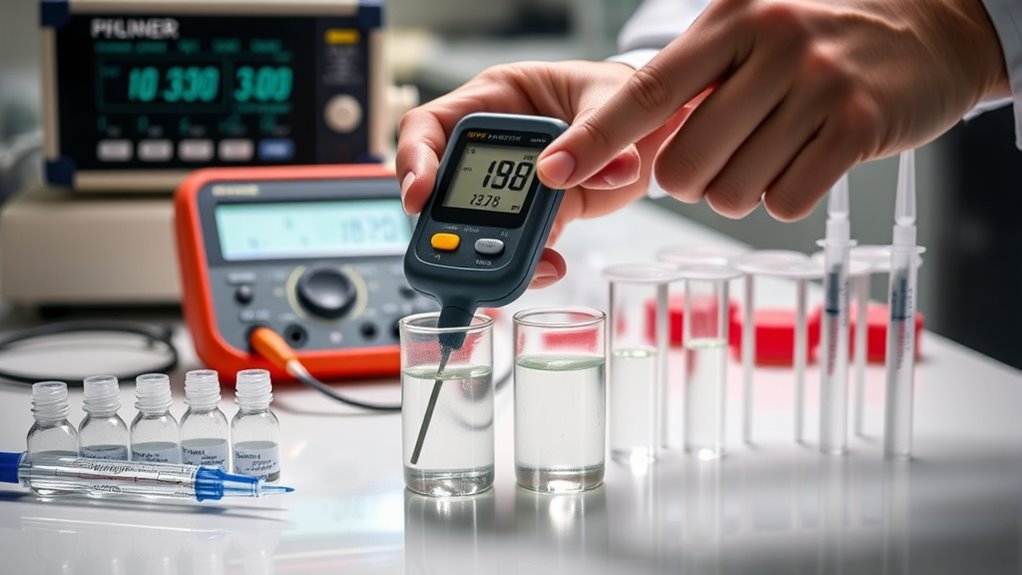
Calibrating EC and pH meters is essential to guarantee accurate measurements in your water testing routine. Proper calibration ensures that your readings reflect true water quality, which is critical for applications like hydroponics, aquaculture, or laboratory analysis. To achieve this, you need to pay close attention to sensor maintenance and calibration frequency. Regularly maintaining your sensors not only prolongs their lifespan but also keeps your measurements reliable. Cleaning the sensors after each use with appropriate solutions prevents buildup of residues that can skew readings. For pH meters, gently rinsing the electrode with distilled water and avoiding harsh scrubbing helps maintain sensor integrity. Similarly, for EC meters, rinsing with distilled water and carefully drying the sensors prevents cross-contamination and corrosion. Using proper storage solutions can also help maintain sensor responsiveness over time. In terms of calibration frequency, it’s best to calibrate your EC and pH meters at least once a week if you use them frequently. In more demanding environments or with sensors that see heavy use, calibrate more often—daily, if necessary. Consistent calibration helps catch drift in sensor accuracy caused by aging or exposure to harsh solutions. When calibrating, always start with fresh calibration solutions that match your expected measurement range. For pH meters, use standard buffer solutions at pH 4, 7, and 10, depending on your application. For EC meters, utilize standard solutions with known electrical conductivity values. Follow the manufacturer’s instructions carefully for both calibration and sensor maintenance routines; this minimizes errors and extends sensor life. Proper handling and sensor care prevent damage and ensure precise readings over time. Sensor maintenance is not a one-time task but an ongoing process. Regularly inspecting your sensors for signs of damage or deterioration allows you to replace or service them before inaccuracies become significant. Keep calibration records to track how often you need to recalibrate or replace sensors, which can save you time and money in the long run. When calibrating, use a clean, stable environment to avoid fluctuations caused by temperature changes or vibrations. Always rinse sensors thoroughly with distilled water after calibration to remove any residual calibration solution. Properly stored sensors, ideally in a storage solution recommended by the manufacturer, will maintain their responsiveness and accuracy longer.

pH Calibration Solution Kit (4,7,10 pH Buffer Solution) & pH Electrode Storage Solution 3 * 50ml pH Buffer Calibration Solution + KCl pH Probe Storage Solution for All pH Meters with High Accuracy
Precisely Calibrate & Protect Your pH Meters – The GIDIGI pH Solution Kit includes 3x50ml pH buffer calibration…
As an affiliate, we earn on qualifying purchases.
As an affiliate, we earn on qualifying purchases.
Frequently Asked Questions
How Often Should I Calibrate My EC and Ph Meters?
You should calibrate your EC and pH meters regularly as part of your maintenance routines, ideally once a week or before each use. This guarantees accurate readings and reliable data. If you’re working with sensitive applications or extreme conditions, consider calibrating more frequently. Consistent calibration maintains your meters’ precision and prolongs their lifespan, so make it a priority in your routine to keep your measurements trustworthy and your results consistent.
Can I Calibrate My Meters With Tap Water?
Did you know that over 80% of calibration errors come from using improper solutions? You shouldn’t calibrate your EC and pH meters with tap water, as it contains minerals and impurities that skew accuracy. Tap water can compromise calibration accuracy, leading to unreliable readings. Instead, use proper calibration solutions to guarantee precise measurements. This guarantees your meters perform at their best and provides trustworthy data for your applications.
What Are Common Signs of a Poorly Calibrated Meter?
You’ll notice incorrect readings when your meter consistently shows values outside the expected range, indicating calibration errors. Common signs include unstable or drifting measurements, slow response times, or readings that don’t match known sample values. If your meter doesn’t recalibrate easily or gives inconsistent results after calibration attempts, it’s a sign it may be poorly calibrated, and you should recalibrate or check for issues to guarantee accuracy.
How Do Temperature Fluctuations Affect Calibration Accuracy?
Temperature fluctuations can considerably impact your calibration accuracy because EC and pH meters rely on stable conditions. When temperatures change, you need to use temperature compensation to guarantee correct readings. Regular calibration frequency helps you catch these variations early, maintaining accuracy. Always check your meter’s calibration after temperature shifts, especially if readings seem inconsistent, and adjust accordingly to keep measurements precise.
Are There Specific Storage Tips for Calibration Solutions?
You should store calibration solutions in airtight, labeled storage containers to prevent contamination and evaporation. Keep them in a cool, dark place to maintain solution freshness and accuracy. Avoid exposing them to direct sunlight or temperature extremes, which can degrade their effectiveness. Always check expiration dates, and replace solutions as needed to ensure precise calibration. Proper storage helps extend their lifespan and guarantees reliable readings during your calibration process.
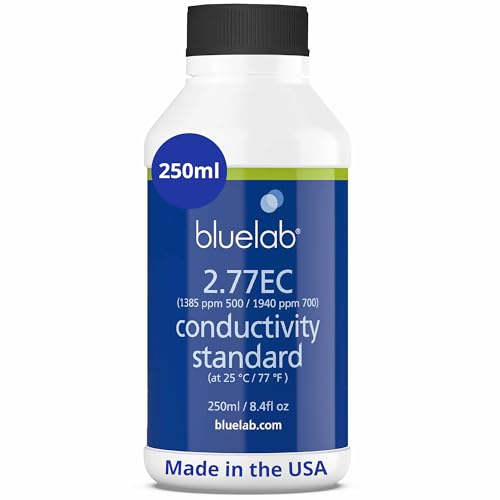
BlueLab 2.77EC Conductivity Solution, 250 milliliters
2.77 EC conductivity standard solution used to verify accuracy of EC and PPM meters
As an affiliate, we earn on qualifying purchases.
As an affiliate, we earn on qualifying purchases.
Conclusion
By calibrating your EC and pH meters properly, you guarantee accurate readings that lead to healthier plants and better water management. Did you know that studies show improperly calibrated meters can cause up to a 20% error in measurements? That’s significant when it comes to optimizing growth conditions. So, take the time to calibrate regularly—you’ll save money, improve crop yields, and enjoy more reliable results. Accurate calibration is your key to success!

Tadeto Soil pH Tester, High Accuracy Digital pH Meter for Soil, Garden, Water, Plants, Solution and Food, Soil pH Test Kit with Thermometer LCD Display, Calibration Powder and Alloy Protective Cap
pH Measurement: This pH meter offers great versatility to accurately measure the PH value of a wide range…
As an affiliate, we earn on qualifying purchases.
As an affiliate, we earn on qualifying purchases.

Varify 17in1 Complete Drinking Water Test Kit – 100 Strips + 2 Bacteria Tester Kits – Well, Tap, Home, City Water Testing Strip for Lead, Alkaline, Chlorine, Hardness, Iron, Fluoride, Copper & More
17 IMPORTANT PARAMETERS: The Varify Premium Drinking Water Test Kit offers an unrivaled, complete analysis of your drinking…
As an affiliate, we earn on qualifying purchases.
As an affiliate, we earn on qualifying purchases.