
TL;DR

Get garden gear delivered free with Prime
- Fast, free delivery on millions of items
- Prime Video, Amazon Music and more included
- Member-only deals all year
A gardener tested the Florida weave trellising system for tomatoes, finding it to be a versatile, budget-friendly, and space-saving alternative to traditional cages. The method proved effective for supporting both indeterminate and determinate varieties, with ongoing lessons on maintenance.
A home gardener has successfully adopted the Florida weave trellising method for supporting tomato plants, replacing traditional cages with a simple, cost-effective system. This development offers an accessible alternative for growers seeking to optimize space, reduce costs, and simplify maintenance.
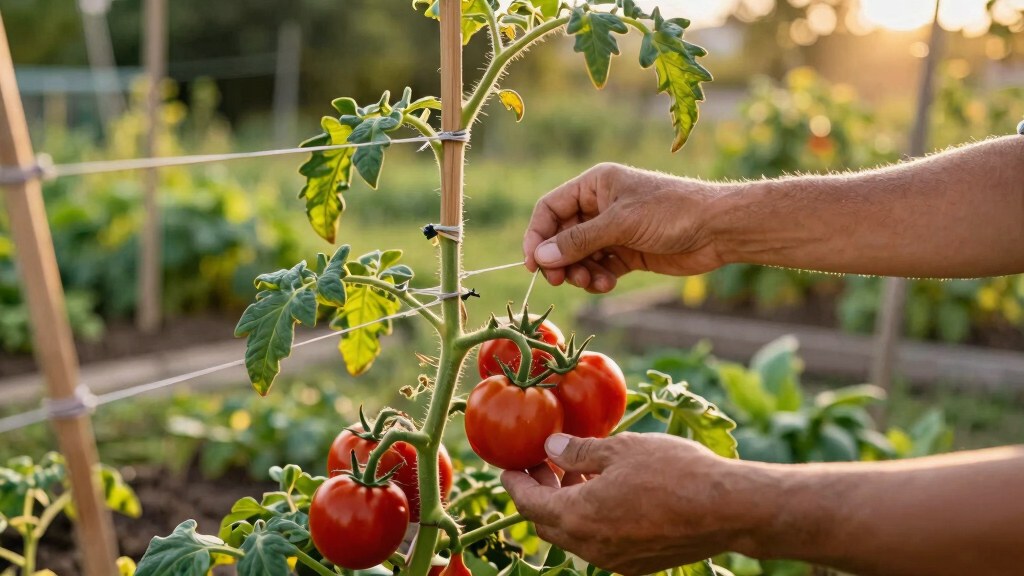
The gardener, who previously used metal or plastic tomato cages that often rusted or broke, constructed a trellis system using wooden stakes and cotton twine. She planted about three dozen tomatoes, spacing them 24 inches apart, and installed the trellis immediately after planting. The system involves weaving twine between stakes to create a zigzag support pattern, which gently sandwiches the tomato stems and holds them upright.
Throughout the season, the gardener added additional layers of twine as plants grew, maintaining tension to support the increasing height. She noted that the system kept plants tidy, improved ease of harvesting and weeding, and required less storage space during winter. She also reported that the system was easy to construct, inexpensive, and simple to replace after each season.
Advantages of the Florida Weave for Home Gardeners
This method offers a cost-effective, space-saving alternative to traditional tomato cages, making it accessible for gardeners with large or small plots. Its simplicity and adaptability can encourage more sustainable gardening practices, reducing plastic waste and storage needs. The gardener’s positive experience suggests that the Florida weave could become a preferred support system for home growers and small-scale farmers alike.
Products Worth Considering

Greenworks 48V (2 × 24V) 20-Inch Brushless Cordless Push Lawn Mower with Two 4.0Ah Batteries and Dual-Port Charger

Orbit B-hyve XD 4-Port Smart Hose Watering Timer with Wi-Fi Hub

Husqvarna 122C 22-cc 2-Cycle Gas String Trimmer, 17-Inch Curved Shaft
As an affiliate, we earn on qualifying purchases.
Growing Popularity of Alternative Tomato Support Systems
The Florida weave, also known as the basket weave, has gained recognition among home gardeners and small-scale farmers as a flexible, affordable trellising method. It is especially useful for indeterminate tomatoes that grow tall and require sturdy support. The system’s popularity stems from its minimal material requirements and ease of installation, contrasting with traditional cages that can be costly and cumbersome to store.
Previous reports from gardening experts, including Bob Vila, have highlighted the system’s benefits, but widespread adoption remains limited. This gardener’s firsthand account adds practical insights into its implementation and effectiveness in real-world conditions.
“The Florida weave is a game-changer for my tomato support system. It’s inexpensive, easy to set up, and keeps my plants tidy.”
— Gardener
Long-Term Durability and Maintenance Questions
It is not yet clear how the Florida weave system performs over multiple seasons, especially regarding the durability of twine and stakes under adverse weather conditions. Further observation is needed to determine if the system maintains support and structural integrity over time.
Monitoring and Improving the Florida Weave System
The gardener plans to continue using the Florida weave method and will monitor plant health, support stability, and ease of maintenance over subsequent seasons. Future steps include experimenting with different materials, stake heights, and weaving patterns to optimize support and longevity.
Key Questions
Is the Florida weave suitable for all types of tomatoes?
Yes, the Florida weave can support both determinate and indeterminate tomato varieties, though stake height and twine tension may need adjustment based on plant growth.
What materials are best for constructing a Florida weave trellis?
Sturdy stakes such as wood, bamboo, or steel, combined with durable twine like cotton or waxed string, are recommended for effective support.
How often should I replace the twine in the system?
It is advisable to replace the twine at the end of each growing season to prevent wear and potential plant damage.
Can the Florida weave be used in small gardens?
Absolutely, the system is highly adaptable and can be scaled down to fit smaller garden plots with fewer plants.
What are the main challenges of using the Florida weave?
Potential sagging of twine over time and the need for periodic tension adjustments are common challenges. Proper installation and material choice can mitigate these issues.
Source: Bob Vila