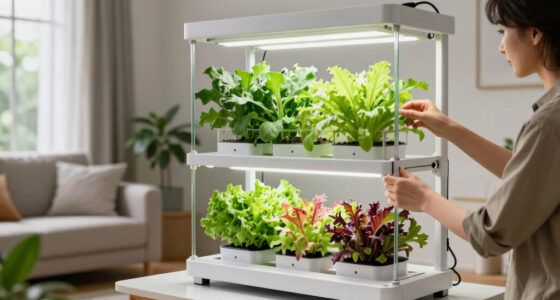
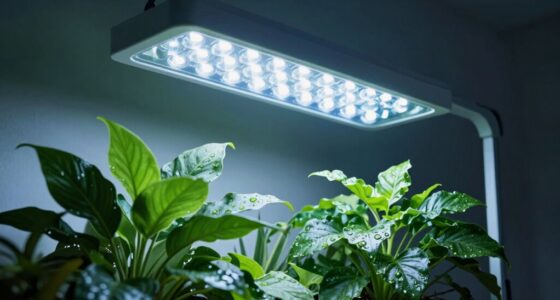
Tunable spectrum lights are most effective if you grow your plants with precise environmental control, consistent practices, and tailored strategies. You need to match the light spectrum to different growth stages and guarantee your environment—temperature, humidity, airflow—is optimized. Pest control and proper nutrition also boost results. Without these supporting conditions, the full benefits won’t be realized. Keep exploring to discover how to ensure your growing setup maximizes the power of tunable lights.

Get garden gear delivered free with Prime
- Fast, free delivery on millions of items
- Prime Video, Amazon Music and more included
- Member-only deals all year
Key Takeaways
- They are most effective when used in controlled indoor environments with stable temperature, humidity, and airflow.
- Proper results depend on aligning spectral adjustments with specific plant growth stages and goals.
- Pest control and healthy plant management are essential to maximize the benefits of tunable spectrum lighting.
- Integrating environmental management and precise nutrition enhances the effectiveness of spectral customization.
- They require a dedicated, knowledgeable grower committed to optimizing environmental and cultivation conditions.

Have you ever wished for lighting that adapts seamlessly to your needs? Tunable spectrum lights give you that flexibility, allowing you to customize the light spectrum to match your specific growing goals. But before jumping in, it’s essential to understand that these lights are most beneficial when you grow a certain way. If your cultivation method isn’t aligned with their capabilities, you might not see the full potential they offer.
When you use tunable spectrum lights correctly, you can optimize plant nutrient uptake. By adjusting the spectrum, you help your plants absorb the right wavelengths during different growth stages. For example, during the vegetative phase, increasing blue light promotes healthy leaf development and robust stems. As your plants transition into flowering, shifting to red and far-red wavelengths can boost flowering and fruiting. This precise control ensures your plants receive exactly what they need at each stage, leading to healthier, more vigorous growth.
However, simply having the technology isn’t enough. To truly benefit from tunable spectrum lights, you need to incorporate effective pest control strategies. The better your pest management, the less likely pests are to weaken your plants or spread diseases, which can diminish the benefits of optimized lighting. When your plants are healthy and stress-free, they respond more effectively to tailored spectra, maximizing growth and yield. Maintaining a clean environment, regular monitoring, and biological controls are key components that complement the benefits of adjustable lighting.
It’s also worth noting that tunable spectrum lights work best if you’re committed to a controlled environment. If you grow outdoors or in a setup with fluctuating conditions, the benefits of spectral adjustments may be limited. Indoor growers who can precisely manage temperature, humidity, and airflow will find these lights most useful. They enable you to fine-tune conditions to support plant health and productivity, especially when combined with strategies like plant nutrient optimization. Proper nutrition, paired with targeted lighting, creates an environment where plants thrive with minimal stress. Additionally, understanding lighting technology and how it integrates with other environmental controls can help you maximize your results. Recognizing the importance of environmental regulation can make a significant difference in achieving optimal plant growth.
In essence, tunable spectrum lights aren’t a magic bullet. They’re a powerful tool meant for growers who understand their plants’ needs and are willing to implement supporting strategies like pest control and nutrient management. When used correctly, these lights can elevate your cultivation, making every stage of growth more efficient and productive. But if your growing approach isn’t aligned with their strengths—such as inconsistent conditions or neglecting pest control—you won’t unlock their full potential. So, if you’re serious about optimizing your grow, these lights are only useful if you grow this way, with a plan that emphasizes precision and plant health. Understanding plant growth stages and how to adapt your environment accordingly can significantly enhance your results.
As an affiliate, we earn on qualifying purchases.
Frequently Asked Questions
Can Tunable Spectrum Lights Save Energy Compared to Traditional Grow Lights?
Tunable spectrum lights can save energy compared to traditional grow lights, especially if you adjust the spectrum to match your plants’ needs, optimizing growth. Their energy efficiency often surpasses older lighting options because you use only the necessary light wavelengths, reducing wasted power. When considering the cost comparison, the higher upfront investment balances out with long-term savings through lower energy bills and better plant health, making them a smart choice.
Are Tunable Spectrum Lights Suitable for All Plant Types?
Tunable spectrum lights are suitable for many plant species, especially if you adjust the spectrum for different growth stages. You can optimize light conditions for seedlings, vegetative, and flowering phases, making them versatile. However, some plants with very specific lighting needs might still require specialized lights. Overall, these lights give you the flexibility to cater to various plant species and growth stages, promoting healthier growth and better yields.
How Long Do Tunable Spectrum Lights Typically Last?
Tunable spectrum lights typically last between 25,000 to 50,000 hours, depending on the quality. Did you know that high-quality LEDs can maintain 70-80% of their original brightness after 40,000 hours? This longevity is mainly due to their durable light spectrum and efficient power design. With proper care, your light’s power longevity guarantees consistent plant growth without frequent replacements, saving you time and money in the long run.
Do Tunable Spectrum Lights Require Special Installation or Setup?
Tunable spectrum lights usually don’t require complex installation or setup procedures. You might need to mount them securely, connect the power supply, and possibly adjust the settings for ideal light spectrum. Check the manufacturer’s instructions for specific installation requirements, as some models may need additional accessories or calibration. Overall, they’re designed to be user-friendly, so you can get your lighting system up and running quickly without much hassle.
Can These Lights Be Used Outdoors or Only Indoors?
You can use tunable spectrum lights outdoors, but plant adaptation and light penetration are key factors. These lights are designed mainly for indoor use, where you can control the spectrum precisely. Outdoors, natural sunlight usually provides better light penetration and broader spectrum. However, if you want to supplement sunlight or grow plants in shaded areas, tunable spectrum lights can help, but they work best when tailored to your plants’ specific needs.
indoor plant grow light with adjustable spectrum
As an affiliate, we earn on qualifying purchases.
As an affiliate, we earn on qualifying purchases.
Conclusion
If you want your plants to thrive, tunable spectrum lights are only part of the equation. You’ve got to grow smart and adapt your methods to match the lights’ capabilities. Remember, you can’t teach an old dog new tricks, but you can certainly help your plants flourish by adjusting your approach. When you harness the full potential of these lights and stay flexible, you’ll see your garden grow leaps and bounds. Don’t put all your eggs in one basket—be versatile and watch your plants thrive.
full spectrum LED grow light for plants
As an affiliate, we earn on qualifying purchases.
As an affiliate, we earn on qualifying purchases.
plant grow light for vegetative and flowering stages
As an affiliate, we earn on qualifying purchases.
As an affiliate, we earn on qualifying purchases.
Halloween Picks
halloween
As an affiliate, we earn on qualifying purchases.