
TL;DR
Research shows that lawn mowing skills vary significantly among individuals due to a combination of experience, technique, and equipment. This article examines why some mow better than others and what factors contribute to the differences.
Recent research indicates that lawn mowing performance varies widely among individuals, with some achieving a more uniform and healthier-looking lawn than others. Experts suggest that this difference stems from factors such as experience, technique, and familiarity with equipment, rather than solely the quality of the mower.
Studies from horticultural and landscaping professionals highlight that those with more practice tend to develop better control over mowing patterns, blade speed, and cutting height, leading to more consistent results. For insights on equipment choices, see Greenworks vs Ryobi Lawn Mowers. Additionally, the choice of equipment—such as mower type and blade sharpness—plays a significant role in the quality of the cut.
While some people may have natural aptitude, the consensus among experts is that proper training and familiarity with lawn care practices can significantly improve mowing quality, regardless of initial skill level. Check out our Greenworks vs Ryobi Lawn Mowers guide for more tips. This understanding has implications for homeowner education and professional landscaping standards.
Implications of Mowing Skills on Lawn Care Quality
The ability to mow a lawn effectively influences the overall health and appearance of the grass, affecting property value and aesthetic appeal. Better mowing techniques can reduce lawn stress, prevent disease, and promote even growth. For homeowners and landscapers, understanding the factors that contribute to superior mowing can lead to improved yard maintenance practices and better resource management.
Furthermore, recognizing that skill and technique matter can inform training programs for amateur gardeners and professional landscapers alike, potentially raising industry standards and encouraging best practices across the board.
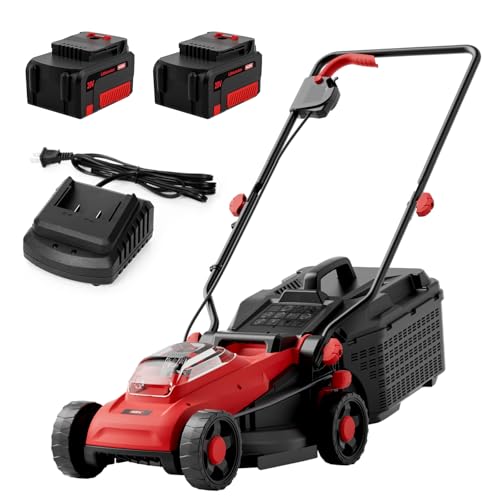
MZK 20V 13-Inch Electric Lawn Mower, Compact Brushless Mower
- Motor Type: Brushless motor for efficiency
- RPM Range: 2800 RPM low, 3400 RPM high
- Cutting Height Settings: 4 adjustable positions
As an affiliate, we earn on qualifying purchases.
As an affiliate, we earn on qualifying purchases.
Factors Influencing Lawn Mowing Performance
Research into lawn care and landscaping has long acknowledged that equipment quality and experience influence mowing results. Recent studies published in 2024 reinforce that individuals with more practice tend to develop better control and technique, leading to more consistent lawns.
Historically, lawn mowing has been viewed as a simple task, but emerging data suggests that skill development plays a significant role. Professional landscapers often undergo training to optimize their mowing technique, which results in higher-quality lawns compared to casual or inexperienced mowers.
Additionally, technological advances, such as robotic mowers and precision equipment, are changing the landscape of lawn care, but human skill remains a critical factor in achieving optimal results.
“Experience and technique are the key differentiators in lawn mowing quality. Those who practice more tend to develop better control and produce more even lawns.”
— Dr. Susan Green, horticultural expert

Grasscool 21'' Deck Troy Bilt Mower Mulching Blades Replacement 942-0741A
- Compatible with Troy Bilt mowers: Fits various Troy Bilt models including TB110 and TB240
- Universal fit for Craftsman and MTD: Compatible with multiple Craftsman and MTD mower models
- Blade type: 21-inch mulching blade for Troy Bilt mowers
As an affiliate, we earn on qualifying purchases.
As an affiliate, we earn on qualifying purchases.
What Factors Are Still Under Investigation?
While studies confirm that experience, technique, and equipment influence mowing quality, it remains unclear how much natural aptitude versus learned skill contributes to performance. The specific training methods that best improve mowing skills are also still being researched.
Additionally, the impact of different lawn types and environmental conditions on individual performance is not yet fully understood, making it difficult to generalize findings across all settings.

SMALL ENGINES REPAIR MADE EASY: A Step-by-Step Illustrated DIY Manual for Diagnosing and Rebuilding 2-Stroke and 4-Stroke Small Engines in Lawn Mowers, Chainsaws, and Generators
As an affiliate, we earn on qualifying purchases.
As an affiliate, we earn on qualifying purchases.
Future Research and Practical Applications in Lawn Care
Researchers plan to conduct controlled experiments to quantify the relative impact of training, equipment, and natural aptitude on mowing quality. These findings could inform best practices and training programs for homeowners and professionals.
In the meantime, industry groups and gardening educators are encouraged to develop resources that emphasize skill development and proper equipment use to improve lawn health and appearance.

EGO POWER+ 21" Cordless Electric Lawn Mower with Battery, Charger – LM2114
- Powerful Cutting Torque: Exceeds gas mower performance with 6.0 ft-lbs torque
- Long Runtime: Up to 55 minutes on a single charge
- Adjustable Cutting Height: Seven positions from 1.25 to 4 inches
As an affiliate, we earn on qualifying purchases.
As an affiliate, we earn on qualifying purchases.
Key Questions
Can anyone improve their lawn mowing skills?
Yes, with practice, proper technique, and the right equipment, most individuals can significantly improve their lawn mowing performance.
Does equipment quality matter more than skill?
Both are important; high-quality equipment can facilitate better results, but skill and technique have a substantial impact on lawn appearance and health.
Are professional landscapers better at mowing than amateurs?
Generally, yes. Professionals typically have more training and experience, which enables them to produce more uniform and healthier lawns.
What training can help improve mowing skills?
Learning proper mowing patterns, blade maintenance, and adjusting cutting height are key areas. Many landscaping courses and online tutorials cover these skills.
Will technological advances replace human skill in lawn mowing?
While robotic mowers and automation are improving, human skill remains crucial for complex tasks, troubleshooting, and optimizing lawn care in diverse conditions.
Source: hn