
TL;DR
The traditional rule that DIY is cheaper no longer holds in 2026. Prebuilt AI workstations can now match or beat DIY prices thanks to bulk buying, they save you setup time, reduce risk, and boost reliability. Choosing between build and buy depends on your priorities for control, speed, and support.
Imagine a sleek, whisper-quiet AI workstation humming with purpose, ready to crunch through datasets or train models. Now ask yourself: do you want to spend weeks sourcing parts, assembling, troubleshooting, and tuning, or would you rather have a ready-to-run system with warranty, support, and validated performance? The answer isn’t as clear-cut as it used to be. In 2026, the age-old debate of build versus buy has shifted. The market has changed—component prices spike, supply chains tighten, and vendors now package more of the heavy lifting. This article will help you weigh the real costs, risks, and benefits of each choice—so you can pick what truly fits your workflow and build vs buy a prebuilt AI workstation.
Build vs buy
an AI workstation.
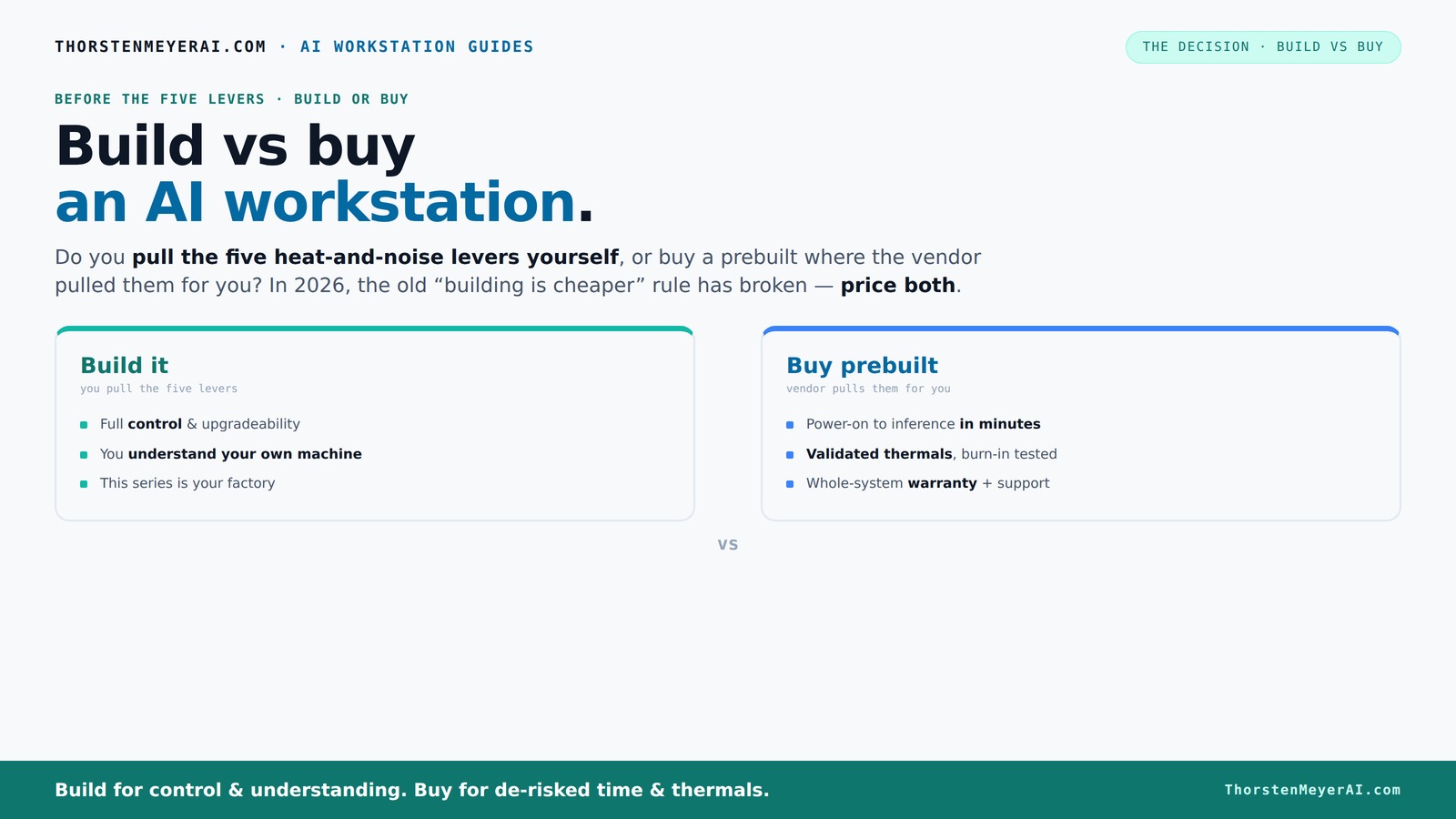
The real question behind this whole series: do you pull the five heat-and-noise levers yourself, or buy a prebuilt where the vendor pulled them for you? And in 2026, the old “building is cheaper” rule has broken. Match your situation in Part 3.
Key Takeaways
- Component shortages in 2026 make prebuilt AI workstations often as affordable as DIY, reversing the long-held price advantage of building.
- Prebuilts save you time, reduce setup risk, and come with validated thermals and support—ideal for fast deployment and reliability.
- Building your own system offers maximum control over cooling, noise, and upgrades but comes with higher troubleshooting overhead and potential delays.
- For multi-GPU workloads or complex AI tasks, vendor-validated prebuilts often outperform DIY setups in thermal management and stability.
- A hybrid approach—buy the base system and customize key parts—strikes a balance between speed, control, and cost.

WIWB Gaming PC Desktop Core I9-14900HX, RTX 5060 Ti 8G, 1TB NVME SSD
- Powerful Processor: Intel Core i9-14900HX with 24 Cores
- High-Performance Graphics: GeForce RTX 5060 Ti 8GB GDDR7
- Fast Memory & Storage: 16GB DDR5 RAM and 1TB NVMe SSD
As an affiliate, we earn on qualifying purchases.
As an affiliate, we earn on qualifying purchases.
Why the 'Build is Cheaper' Myth Crumbles in 2026
Building your own AI workstation used to be the clear winner on price. But today, the reality looks different. Major component shortages—especially for GPUs and DDR5 RAM—have driven prices sky-high. A build that once cost under $1,000 now easily exceeds $1,250—without even factoring in the time spent assembling or troubleshooting.
Meanwhile, big vendors like Lambda and BIZON bought in bulk before the shortages hit. They leverage economies of scale to offer systems at prices that often beat DIY, despite the perceived convenience premium. This shift means that the traditional assumption that building is always cheaper no longer holds. Instead, you need to run the numbers for your specific setup, considering not just raw costs but also the value of your time, the risks of delays, and the potential need for troubleshooting. If a vendor’s bulk discounts can match or beat DIY prices while offering a fully tested, supported system, the economics favor buying. This transition underscores an important tradeoff: is your priority cost savings, or is it reliability and speed? The answer influences whether the myth of DIY cost advantage is still valid in 2026.

HP OmniDesk M03 Business AI Desktop PC Intel Ultra 7-265 (>i9-14900)
- Upgrade Warranty Coverage: Certified RAM/SSD upgrades with 3-year warranty
- High-Performance Processor: Powered by Intel Ultra 7-265 processor
- Versatile Use: Suitable for creative, productivity, and AI tasks
As an affiliate, we earn on qualifying purchases.
As an affiliate, we earn on qualifying purchases.
Who Pulls the Levers? Control vs Convenience in Heat and Noise
Building your own AI machine gives you hands-on control over every detail—GPU undervolting, custom cooling, airflow setup, fan tuning. This level of control allows you to optimize for specific workloads and environmental conditions, potentially squeezing out maximum performance while minimizing noise. However, this also means you need to understand thermal dynamics and be prepared for trial-and-error tuning—an ongoing process that can be time-consuming and requires expertise. If your workload involves sustained multi-GPU training or operating in a noise-sensitive environment, this control can be crucial. But it also introduces risks: a misconfigured cooling system can lead to thermal throttling, hardware damage, or excessive noise, which can derail productivity and increase costs.
Prebuilt vendors, on the other hand, handle all that for you. They validate thermals, tune fan curves, and often include water-cooling or specialized cases that run whisper-quiet under load. Companies like Puget Systems and Lambda test their systems for 24-48 hours under load before shipping, so you’re guaranteed a machine that won’t throttle or scream. This approach reduces your need for technical expertise and ongoing maintenance, providing a stable environment for AI workloads. The tradeoff is less granular control—if you need custom cooling solutions or specific thermal configurations, prebuilts might not fully satisfy those needs. But for most users, the convenience and reliability outweigh the ability to fine-tune every parameter.

Mastering AI Workstations for High-Performance Computing: Your Guide to Configuring, Optimizing, and Harnessing the Power of AI-Ready Workstations for Maximum Productivity
As an affiliate, we earn on qualifying purchases.
As an affiliate, we earn on qualifying purchases.
Cost Breakdown: Price Tag vs Hidden Costs
| Build | Buy |
|---|---|
|
|
Understanding these hidden costs is vital because initial price comparisons often overlook the ongoing expenses of troubleshooting, system downtime, and upgrades. Building may appear cheaper on paper, but the time and effort required—especially amid component shortages—can significantly inflate total ownership costs. Conversely, prebuilts, despite their higher sticker price, often deliver better value through reduced hassle, faster deployment, and more predictable performance, which can be critical for time-sensitive AI projects.

NVD RTX PRO 6000 Blackwell Professional Workstation Edition Graphics Card for AI, Design, Simulation, Engineering - 96GB DDR7 ECC Memory - 4th Gen RT/5th Gen Tensor Core GPU - OEM Packaging
- Advanced Streaming Multiprocessor: Enhanced throughput and neural shaders
- Double-Flow-Through Cooling: Optimized airflow for peak performance
- 5th Gen Tensor Cores: Up to 3X AI performance, FP4 support
As an affiliate, we earn on qualifying purchases.
As an affiliate, we earn on qualifying purchases.
Performance for AI Workloads: Does It Matter How You Get There?
Performance isn’t just about raw specs; it’s about how well your system handles AI workloads—training, inference, data processing. Building allows you to pick specific GPUs, custom cooling, and tailored RAM configurations—crucial for demanding tasks like multi-GPU training or large language models. This customization can yield performance gains, especially if you fine-tune settings for your specific workload. However, it also introduces complexity—if not done properly, thermal issues or bottlenecks can negate these benefits.
Prebuilts often come with validated setups optimized for stability and noise, but with less flexibility. For example, a Lambda workstation tested for multi-GPU loads ensures no thermal throttling, so you can push models like GPT-4 or stable diffusion without surprises. This validation reduces the risk of performance bottlenecks and ensures consistent results across deployments, which is especially important in professional environments where stability is critical.
Imagine a data scientist running hundreds of inference jobs. A prebuilt might save time and reduce risk, but a build can be fine-tuned for maximum VRAM, faster PCIe lanes, or specific cooling needs—like a custom water loop for ultra-quiet operation. The choice depends on whether your priority is quick deployment with proven stability or maximum tailored performance for niche workloads.
Support, Warranty, and Future Upgrades—Why They Tip the Scale
If your AI system fails mid-training, you want fast, reliable support. Prebuilt vendors like Puget or Lambda offer warranties—up to 5 years in some cases—and validated systems that reduce troubleshooting time. This support ensures minimal downtime and quick resolution, which can be critical when deadlines are tight or data is valuable.
Building your own means you’re on your own for repairs, BIOS updates, and thermal tweaks. Upgrading GPUs or adding RAM down the line is possible but can involve compatibility issues and more DIY troubleshooting. This can lead to longer downtimes and increased costs if issues arise unexpectedly. For professional or production environments, the assurance of manufacturer support and warranty can outweigh the initial savings of a DIY build, especially when system stability and uptime are paramount.
Think of it as buying a car with roadside assistance versus fixing your own engine in the driveway. The choice depends on how much risk you’re willing to accept and how much support you prefer. For mission-critical AI workloads, the peace of mind offered by comprehensive support can be invaluable, reducing stress and unplanned expenses.
When a Hybrid Approach Makes Sense
Sometimes, the best strategy isn’t all-or-nothing. You can buy a solid prebuilt base—like a Lambda or BIZON system—and then customize certain parts: adding more storage, swapping in a quieter GPU, or tuning the cooling for silence. This hybrid approach allows you to leverage the reliability and validated performance of a prebuilt while tailoring specific components to your workflow, striking a balance between convenience and control.
For example, a researcher might purchase a prebuilt system but replace the SSDs with faster NVMe drives for data-heavy tasks, or add extra RAM modules to handle larger datasets. This approach minimizes the risk of compatibility issues and reduces the time spent troubleshooting, while still giving you some level of customization. It’s especially advantageous if you need a proven platform but have unique workload requirements that standard configurations don’t fully address.
Overall, this strategy empowers you to optimize your system based on real needs, reducing both upfront costs and ongoing maintenance, and enabling a more tailored, efficient AI setup.
Frequently Asked Questions
Is a prebuilt AI workstation worth it, or should I build my own?
In 2026, for most users, a prebuilt AI workstation offers faster setup, validated thermals, and support—making it worth the extra cost for reliability and speed. Building can be cheaper but requires time, expertise, and troubleshooting.Which is cheaper long term: build or buy?
While building might seem cheaper upfront, hidden costs for troubleshooting, upgrades, and potential delays often make prebuilts more cost-effective over a 3-year span. Actual costs depend heavily on component prices and your technical skills.How much performance do I lose by choosing prebuilt?
Most prebuilts are tuned for stability and thermal efficiency, often matching custom builds in performance. Custom builds can be fine-tuned for specific workloads, but for general AI tasks, the gap is minimal.What matters most for AI workloads: GPU, RAM, CPU, or storage?
GPU VRAM and CUDA cores are usually the most critical for training and inference. RAM is vital for data handling, and CPU matters for data preprocessing. Storage speed affects data loading times. Balance based on your workload.Can a prebuilt workstation handle local LLMs, training, or fine-tuning?
Yes. Many prebuilt systems are designed for high GPU counts and large VRAM, making them suitable for local LLM inference, fine-tuning, and even training, especially when validated for sustained loads.Conclusion
The decision between build and buy in 2026 isn’t just about saving money. It’s about how quickly you need to get started, how much control you want, and how much support you value. For most, prebuilt systems now offer a compelling blend of performance, reliability, and convenience—especially in a market where component prices and shortages challenge traditional assumptions.
Ask yourself: do you want to be the thermal engineer, or the user? Whichever path you choose, remember—your AI journey depends on the machine that powers it. Make the choice that gets you from zero to inference faster, without sacrificing stability or peace of mind.