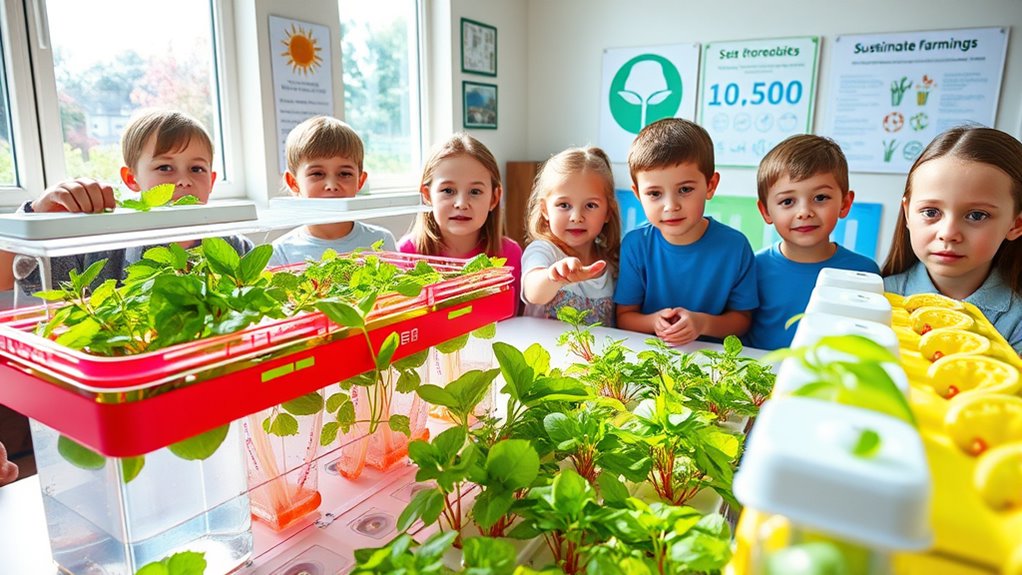

Hydroponic kits with classroom curriculum can support lessons in plant growth, roots, and water-based growing, but these six options vary in how much structure and equipment they provide. I’d put the TTS Hydroponic Smart Garden 7-Compartment Classroom System first for group instruction, while the T&K Hydroponics Lab stands out for biology and sustainable-energy experiments. The Plant Growing Science Kit offers a broader set of botany activities, though it is less centered on a shared classroom growing system. The main tradeoff is between a kit built for repeated group use and smaller kits focused on guided experiments or observation. Read on for the full breakdown and help matching a kit to your class size, lesson goals, and students’ ages.

Get garden gear delivered free with Prime
- Fast, free delivery on millions of items
- Prime Video, Amazon Music and more included
- Member-only deals all year
Complete the kit


Key Takeaways
- The TTS seven-compartment system is the clearest classroom-scale choice in this lineup; its multiple growing spaces suit group observation better than the individual root-viewer kits.
- The T&K Hydroponics Lab has the strongest explicit connection to biology and sustainable energy, making it a better fit for cross-topic experiments than a kit centered mainly on plant viewing.
- The 19-experiment Plant Growing Science Kit offers breadth, but buyers should distinguish a range of botany activities from a full class hydroponic setup.
- Klever Kits and the Root Viewer Science Kit prioritize visible root growth and hands-on discovery; they suit younger learners and small groups better than whole-class cultivation.
- The two listed TTS entries have the same product name, so the roundup cannot treat them as distinct models or claim differences without verified specifications.
| TTS Hydroponic Smart Garden 7-Compartment Classroom System |  | Best Overall for Standards-Aligned Classrooms | Brand: TTS | Type: Hydroponic Smart Garden | Growing capacity: 7 individual compartments | VIEW ON AMAZON | See Our Full Breakdown |
| TTS Hydroponic Smart Garden 7-Compartment Classroom System |  | Best for Shared Classroom Demonstrations | Brand: TTS | System: Hydroponic Smart Garden | Compartments: 7 | VIEW ON AMAZON | See Our Full Breakdown |
| Klever Kits 2-in-1 Root Viewer & Planting Science Kit for Kids – STEM Learning Gift for Ages 6+ |  | Best for Beginner Root Comparisons | Brand: Klever Kits | Kit format: 2-in-1 root viewer and planting science kit | Recommended age: 6+ | VIEW ON AMAZON | See Our Full Breakdown |
| T&K Hydroponics Lab | Biology & Sustainable Energy Experiment Set |  | Best Guided Build-and-Grow Activity | Brand: Thames & Kosmos | Recommended age: 8+ | Included components: Seed packet with three kinds of lettuce seeds, plastic greenhouse, string, and cotton balls | VIEW ON AMAZON | See Our Full Breakdown |
| Plant Growing Science Kit for Kids – 19 Botany Experiments with Hydroponic Growing, Root Science & Transpiration |  | Best for Experiment Variety | Recommended age: 8–12 years | Experiment count: 19 botany experiments | Set name: STEM Plant Growing Kit | VIEW ON AMAZON | See Our Full Breakdown |
| Root Viewer Science Kit for Kids – Grow Your Own Plant STEM Toy & Gardening Kit for Ages 6-12 |  | Best for Root-Growth Observation | Recommended age: 6 years and up | Growing methods: Soil and hydroponic systems | Included components: Viewer box, soil, hydroponic system, journal, stickers | VIEW ON AMAZON | See Our Full Breakdown |
| hydroponic kits with classroom curriculum | Brand | Recommended age | Material | Included components |
|---|---|---|---|---|
| TTS Hydroponic Smart Garden 7- | TTS | — | — | — |
| TTS Hydroponic Smart Garden 7- | TTS | — | — | — |
| Klever Kits 2-in-1 Root Viewer | Klever Kits | 6+ | Plastic | — |
| T&K Hydroponics Lab | Biology | Thames & Kosmos | 8+ | Plastic | Seed packet with three kinds of lettuce seeds, plastic greenhouse, string, and cotton balls |
| Plant Growing Science Kit for | — | 8–12 years | — | Cotton balls, cups, flower pots, rulers, tweezers, wiggly eyes, sponge, magnifier, test tubes, test-tube stands, and hydroponic baskets |
| Root Viewer Science Kit for Ki | — | 6 years and up | Plastic | Viewer box, soil, hydroponic system, journal, stickers |
More Details on Our Top Picks
TTS Hydroponic Smart Garden 7-Compartment Classroom System
For teachers who want one growing system to anchor a unit across several grades, this TTS seven-compartment garden is the strongest curriculum fit here. Its stated links to multiple NGSS life-science and sustainability standards give lesson planning a clearer starting point than the more activity-led Klever Kits Root Viewer & Planting Science Kit. Visible roots and separate growing spaces also let students compare plant development while a crop moves from germination toward harvest within a semester. The soil-free, nutrient-water setup provides a concrete way to discuss water conservation, with the product claiming up to 90% less water use than soil farming. The tradeoff is that this is a classroom growing system, not a self-running lesson package: educators need to monitor nutrient levels and water quality, and the compartments suit herbs and greens rather than large crops.
Pros:- Explicit alignment with multiple listed K-12 NGSS standards supports standards-based lesson planning.
- Visible roots make germination and development easier to observe directly.
- Seven individual compartments allow several small plants or growth observations at once.
- The claimed water savings support practical lessons about agricultural sustainability.
Cons:- Requires regular checks of nutrient levels and water quality.
- Growing spaces are suited to small plants such as herbs, greens, and microgreens, not large crops.
Best for: K-12 teachers planning a semester-long plant science unit that needs explicit NGSS connections and visible growth observations.
Not ideal for: Teachers seeking a low-maintenance kit with a complete activity sequence, or students growing large crops beyond herbs and greens.
- Brand:TTS
- Type:Hydroponic Smart Garden
- Growing capacity:7 individual compartments
- Curriculum alignment:NGSS: K-LS1-1, 2-LS2-1, 3-LS1-1, 4-LS1-1, 5-LS1-1, MS-LS1-6, MS-ESS3-3, MS-LS2-4
- Growing medium:Nutrient-enriched water; soil-free
- Water efficiency:Up to 90% less water than soil farming
- Suitable plants:Herbs, salad greens, microgreens, and edible flowers
Our verdict“Choose this TTS system when standards alignment and semester-long observation matter more than a ready-made, low-maintenance activity kit.”
TTS Hydroponic Smart Garden 7-Compartment Classroom System
This version of the TTS seven-compartment system makes a good case for classrooms and libraries that need a compact, shared plant-growth demonstration. Recirculating water and seven planting spaces support side-by-side observation of herbs, greens, or microgreens, while the stated reduction of up to 90% in water use gives sustainability discussions a physical example. Compared with the other TTS listing, B0CH3PFCPX, its supplied details describe NGSS support broadly rather than naming specific standards, so teachers who need precise curriculum mapping may prefer that more explicitly documented listing. Like the Klever Kits Root Viewer, it makes roots and growth observable, but it is better suited to ongoing group use than a small individual activity. It still needs nutrient-water maintenance, and its compact scale cannot support large crops or commercial growing.
Pros:- Seven compartments support multiple plants or comparisons in a shared learning space.
- Recirculating water gives students a visible example for water-use and sustainability lessons.
- Designed for classroom, homeschool, and STEM-program use.
- Supports observation of germination, roots, and plant growth.
Cons:- Requires nutrient-water solutions and ongoing system maintenance.
- The supplied curriculum information is less specific than the NGSS standard list for the other TTS listing.
- Its small growing scale is unsuitable for large crops or commercial gardening.
Best for: Teachers, homeschool groups, and school librarians who want a compact shared system for observing several small plants over time.
Not ideal for: Educators who need a detailed standards-by-grade mapping in the product information, or classes studying large-scale crop production.
- Brand:TTS
- System:Hydroponic Smart Garden
- Compartments:7
- Plant types:Herbs, salad greens, microgreens, and edible flowers
- Water system:Recirculating water
- Water use:Up to 90% less than soil farming
- Educational standards:Supports K-12 NGSS plant and life-science standards
- Intended use:Classroom, homeschool, and STEM programs
Our verdict“Pick this TTS listing for a shared, compact classroom growing demonstration, but favor the other TTS listing when specific NGSS codes are a priority.”
Klever Kits 2-in-1 Root Viewer & Planting Science Kit for Kids – STEM Learning Gift for Ages 6+
For younger learners, the two-method format is the main reason to choose the Klever Kits Root Viewer: children can compare hydroponic and soil planting rather than study hydroponics alone. Its transparent root viewer turns development below the surface into something students can watch, while included seeds, expanding soil, and stickers help make a first planting activity approachable. That makes it a more personal, hands-on starter than either TTS classroom system, which offers more compartments and clearer classroom-scale curriculum links. The tradeoff is depth: the supplied details name STEM learning but do not identify NGSS standards or a structured classroom curriculum. It is also a manual indoor activity for ages six and up, not a long-running, multi-station grow system. Older students seeking broader experiments may get more learning range from the 19-experiment Plant Growing Science Kit.
Pros:- Combines hydroponic and soil planting for a straightforward comparison activity.
- Transparent viewer makes root growth visible to children.
- Includes seeds, expanding soil, and stickers for a ready-to-start activity.
- Manual operation gives children a direct role in planting and observation.
Cons:- Product details do not specify standards alignment or a structured classroom curriculum.
- The activity scope may be too basic for older children or advanced learners.
- Intended for indoor use and requires supervision for younger children.
Best for: Parents and early-elementary educators introducing children ages 6 and up to root observation and basic comparisons between soil and hydroponic planting.
Not ideal for: Teachers needing explicit NGSS alignment, a multi-plant classroom system, or an extended set of experiments for older students.
- Brand:Klever Kits
- Kit format:2-in-1 root viewer and planting science kit
- Recommended age:6+
- Planting methods:Hydroponic and soil planting
- Included materials:Seeds, stickers, and fast-expanding soil
- Material:Plastic
- Operation mode:Manual
- Use:Indoor
Our verdict“Choose this kit for a simple first root-science activity, not as a substitute for a standards-mapped classroom hydroponic system.”
T&K Hydroponics Lab | Biology & Sustainable Energy Experiment Set
The T&K Hydroponics Lab is the best fit here for a teacher or parent who wants children to assemble a small greenhouse and follow a guided grow activity. Its manual covers planting, care, and harvesting, while the lettuce seeds and greenhouse parts give the lesson a clear beginning-to-end shape. Compared with the TTS systems, this set is a more contained project rather than a seven-compartment classroom growing station; compared with Klever Kits, it centers on building and tending a greenhouse instead of comparing soil and hydroponic methods. Its curriculum promise also has limits: the product description mentions biology and sustainable energy concepts but supplies no specific standards mapping. Three lettuce varieties keep the activity focused, and younger users may need help with assembly and supervision during setup.
Pros:- Manual guides planting, tending, and harvesting in a defined sequence.
- Greenhouse components make assembly part of the hands-on learning activity.
- Includes three kinds of lettuce seeds for a focused food-growing project.
- Connects hydroponic gardening with biology and sustainable-energy concepts.
Cons:- The seed selection is limited to three types of lettuce.
- Product details do not provide specific curriculum standards or standards-by-grade mapping.
- Assembly may be challenging for some children, and younger users need adult supervision.
Best for: Families and educators working with children ages 8 and up who want a guided greenhouse assembly, lettuce-growing, and harvest activity.
Not ideal for: Teachers seeking several plant types, explicit NGSS codes, or a reusable multi-compartment setup for repeated classroom comparisons.
- Brand:Thames & Kosmos
- Recommended age:8+
- Included components:Seed packet with three kinds of lettuce seeds, plastic greenhouse, string, and cotton balls
- Model number:550077
- Dimensions:9.7 x 3.5 x 11.5 inches
- Weight:0.45 kg
- Material:Plastic
Our verdict“Choose this set for a guided build-and-grow project; select a TTS system instead for broader classroom capacity and more explicit standards support.”
Plant Growing Science Kit for Kids – 19 Botany Experiments with Hydroponic Growing, Root Science & Transpiration
When the goal is to teach several botany ideas rather than maintain one garden, this kit’s 19 experiments give it a distinct advantage. Activities cover plant growth, hydroponics, roots, and transpiration, and the included tools—such as a magnifier, rulers, test tubes, and hydroponic baskets—support observation and simple measurement. That breadth makes it a better match for a sequence of classroom or homeschool activities than the T&K Hydroponics Lab, which focuses on building and harvesting a lettuce greenhouse. It also reaches beyond the introductory root-viewing activity in Klever Kits. The tradeoff is that a high activity count is not the same as explicit curriculum mapping: the supplied details do not name NGSS standards or provide a grade-by-grade scope. Some experiments take several days, and younger children need adult supervision.
Pros:- Nineteen experiments cover hydroponics, root science, plant growth, and transpiration.
- Included tools support observation and measurement, not just planting.
- Hydroponic baskets and other materials enable hands-on growing activities.
- The activity range suits classroom and homeschool use.
Cons:- Product details do not specify standards alignment or a structured grade-by-grade curriculum.
- Some experiments take several days, so activities are not all immediate.
- Younger children require adult supervision.
Best for: Homeschool families and teachers of roughly ages 8–12 who want varied, hands-on botany activities using observation and measurement.
Not ideal for: Buyers seeking a single, low-maintenance hydroponic garden or documented NGSS alignment for lesson planning.
- Recommended age:8–12 years
- Experiment count:19 botany experiments
- Set name:STEM Plant Growing Kit
- Included components:Cotton balls, cups, flower pots, rulers, tweezers, wiggly eyes, sponge, magnifier, test tubes, test-tube stands, and hydroponic baskets
- Number of items:1
- Manufacturer:Xinxiang Alpha Manufacturing Ltd.
- ASIN:B0DS3XGD86
Our verdict“Pick this kit for a varied botany activity sequence, but choose a TTS system if your priority is an ongoing garden with explicit NGSS links.”
Root Viewer Science Kit for Kids – Grow Your Own Plant STEM Toy & Gardening Kit for Ages 6-12
I’d choose this kit when the main classroom question is how roots develop, not how to manage a larger hydroponic garden. Its transparent viewer makes growth visible, while the included soil and hydroponic systems let children compare two growing methods. The journal gives students a place to record observations, though the listing doesn’t describe a structured classroom curriculum or a sequence of lessons. Compared with the Plant Growing Science Kit with 19 Botany Experiments, this is a narrower, more focused activity; compared with the TTS Hydroponic Smart Garden 7-Compartment Classroom System, it is a compact individual investigation rather than a multi-compartment class setup. That focus suits younger learners, but the small plastic viewer and reported setup complexity may call for adult guidance. I’d skip it if you need a complete teacher-led curriculum or a durable system for repeated whole-class use.
Pros:- Transparent viewer makes root growth directly observable.
- Includes both soil and hydroponic growing systems for a simple comparison.
- Growth journal supports recording observations.
- Stickers add an engaging activity element for younger learners.
Cons:- The product description does not specify a structured classroom curriculum or teacher guide.
- Setup may be complex for some children without adult help.
- Plastic construction and compact dimensions may limit durability and group use.
Best for: Teachers or caregivers of ages 6–12 who want a compact root-growth observation activity with a journal and a soil-versus-hydroponic comparison.
Not ideal for: Older students, buyers seeking a clearly described lesson plan, or classrooms that need a robust system for simultaneous group growing.
- Recommended age:6 years and up
- Growing methods:Soil and hydroponic systems
- Included components:Viewer box, soil, hydroponic system, journal, stickers
- Material:Plastic
- Dimensions:7 × 2 × 8 inches
- Item weight:16 ounces
- Model number:CT-01
Our verdict“Choose this for a focused, hands-on root-growth lesson for younger children, but pick a larger classroom system or a broader experiment kit for more extensive instruction.”

How We Picked
I compared the six listed products by how directly they support classroom teaching, how clearly their activities connect to plant science, and how practical their format is for the intended group. I also looked at age cues, the kind of observation each kit encourages, and whether its described scope suggests a shared growing system or a focused experiment. A kit with a classroom-sized format or stated curriculum focus ranks ahead of a general STEM toy for teachers seeking structured instruction.
That ranking has limits: the supplied product information does not specify lesson plans, class capacity, refill availability, or detailed equipment for every item. I have not assumed those features. The two TTS listings appear identical by name, so I treat them as one product type rather than inventing a distinction. Buyers should verify included materials and teaching resources before choosing a kit for a particular course or class size.
| hydroponic kits with classroom curriculum | Brand | Included components |
|---|---|---|
| TTS Hydroponic Smart Garden 7- | TTS | — |
| TTS Hydroponic Smart Garden 7- | TTS | — |
| Klever Kits 2-in-1 Root Viewer | Klever Kits | — |
| T&K Hydroponics Lab | Biology | Thames & Kosmos | Seed packet with three kinds of lettuce seeds, plastic greenhouse, string, and cotton balls |
| Plant Growing Science Kit for | — | Cotton balls, cups, flower pots, rulers, tweezers, wiggly eyes, sponge, magnifier, test tubes, test-tube stands, and hydroponic baskets |
| Root Viewer Science Kit for Ki | — | Viewer box, soil, hydroponic system, journal, stickers |
Factors to Consider When Choosing Hydroponic Kits With Classroom Curriculum
Before choosing, decide what you need students to learn and how the kit will fit into everyday classroom routines. A product described as a science kit may support useful observation without supplying a lesson sequence or enough materials for a whole class.
Match the Kit to the Lesson Goal
Start with the learning outcome, not the word “hydroponic” on the package. A lesson about nutrient delivery and growing without soil needs a different setup from a unit about root structure or seed germination. Look for activities that let students observe the concept you plan to teach, rather than relying on a broad STEM label. If the goal spans several subjects, check whether the kit provides experiments or prompts linking plant growth to biology, energy, or environmental science. A common mistake is buying a kit with many activities that do not align with the unit’s central question. Choose a narrower kit when it supports a clear lesson better than a larger but loosely connected activity set.
Check Whether “Curriculum” Means Lesson Support
Curriculum can mean anything from a teacher guide with objectives and discussion prompts to a list of experiments. Before ordering, confirm whether lesson plans, worksheets, vocabulary, or assessment ideas are included, and whether they are digital or printed. Ask how much preparation the teacher must supply and whether activities are suitable for the students’ reading level. Kits without a stated curriculum may still work well when paired with your own materials, but that adds planning time. Do not assume that a product marketed for classroom use includes a full teaching sequence. If ready-to-run instruction matters, verify the resource details with the seller or manufacturer.
Plan for Group Size and Shared Access
Count the students who need direct hands-on time, not just the number of seats in the room. A multi-compartment system can support shared growing observations, while a single root-viewing unit may work better as a rotating station or teacher demonstration. Decide whether every student needs an individual planting task or whether small groups can share equipment and record results. Shared kits can reduce clutter, but they may limit how many students handle materials at once. Individual kits give more direct participation yet can require more storage and organization. Ask about the number of planting spaces and included components before assuming a kit will serve your entire class.
Account for Time, Maintenance, and Repeated Use
Hydroponic activities often unfold over days or weeks, so they need a place in the classroom routine beyond the initial lesson. Consider who will check water, manage light, and keep observations going during weekends or school breaks. A short experiment kit may fit a single unit more easily, while a growing system can offer a longer record of plant development. Check whether consumables or replacement parts are needed after the first activity and whether they are readily available. A frequent planning error is focusing on setup day while overlooking ongoing care. Choose a format your class can maintain consistently, even during busy periods.
Choose an Age-Appropriate Level of Independence
Age guidance is a useful starting point, but students’ fine-motor skills, reading ability, and experience with lab routines also affect fit. Younger learners may benefit from visible roots and simple observations, while older students can take on variables, data collection, and comparisons between growing conditions. Review any small parts, liquid handling, or assembly steps against your school’s safety rules. Consider whether students can complete the activity independently or need close teacher supervision. A kit that is too simple may leave older learners with little to investigate; one that demands too much setup can turn a lesson into troubleshooting. Choose the level that leaves time for students to ask questions and interpret what they observe.
Compare Total Classroom Effort, Not Just the Box Contents
For classroom planning, the hidden costs are often teacher time, storage, cleanup, and replenishment rather than the initial kit alone. Find out what must be supplied separately, such as seeds, growing media, lighting, or containers, rather than assuming the product includes everything for a complete activity. Repeated use may favor a sturdier shared system, while a one-unit lesson may be better served by a simpler experiment kit. Consider where the setup will live and how students will access it without disrupting other work. If the product description is vague, request a full contents list and care instructions before purchase. This check helps prevent a kit from arriving without the materials needed to meet your lesson plan.
Frequently Asked Questions
Does every kit in this roundup include a classroom curriculum?
No. The product names point to different levels of classroom and experiment focus, but the available descriptions do not confirm that every kit includes lesson plans, worksheets, or a teacher guide. The TTS product is explicitly framed as a classroom system, while several other options are described as science or STEM kits. Before buying, check the included-resource list and ask whether curriculum materials cover your grade level and learning objectives. If a full teaching sequence is required, do not rely on the word “science” or “classroom” alone.
Can one kit support a full class, or will I need multiple kits?
That depends on the number of growing spaces and how students will participate. The TTS system’s seven compartments suggest a shared classroom format, but the listing information here does not establish how many students can use it at once. Root-viewer and individual experiment kits may be more suitable for stations, pairs, or small groups than simultaneous whole-class work. Plan the lesson around turns, group roles, and observation journals if equipment is shared. Confirm capacity and included quantities before ordering for a specific class size.
What should I buy if my main goal is teaching hydroponics rather than general plant science?
Prioritize a kit that clearly shows how plants grow without soil and supports repeated observation of that process. The TTS system is the most classroom-oriented choice in this list, while the T&K Hydroponics Lab is the clearer match for lessons combining hydroponics with biology and sustainable energy. The 19-experiment kit covers broader botany topics, so it may suit a wider plant-science unit rather than a focused hydroponics lesson. Check whether the kit includes the materials and instructions needed to demonstrate the growing method you plan to teach. A root viewer can teach plant structure, but root visibility alone does not make it a complete hydroponics curriculum.
Are root-viewer kits a good substitute for a hydroponic classroom system?
They can support lessons about root development and close observation, but they serve a different teaching purpose from a multi-space growing system. Klever Kits and the Root Viewer Science Kit are better understood as hands-on plant observation options, particularly for younger learners or smaller groups. A classroom system is more suitable when students need to compare plants over time or study a shared growing setup. If your unit covers both root structure and hydroponic growing methods, you may need supplemental materials or a second type of activity. Match the kit to the concept you need students to explain, not just what they can see.
What should I verify before using a kit across multiple school terms?
Ask whether the kit can be reused and which parts are consumed or need replacing after an experiment. Check availability of seeds, growing media, nutrients, containers, and any specialized components named in the instructions. Also look for cleaning and storage guidance, since shared classroom equipment needs a routine between groups and terms. The supplied product descriptions do not establish refill availability or long-term durability, so those details need confirmation from the seller or manufacturer. If repeat use is a priority, compare the ongoing care and replenishment plan before choosing based on the initial activity list.
Conclusion
For a class that needs a shared growing setup, I’d choose the TTS Hydroponic Smart Garden 7-Compartment Classroom System as the best overall fit, while confirming its teaching materials and capacity first. The Plant Growing Science Kit is the best value-style pick for teachers seeking a broad range of botany activities, though the listed details do not confirm a full classroom hydroponic system. For a more specialized, cross-topic option, the T&K Hydroponics Lab is my premium-style choice for biology and sustainable-energy lessons; verify its included curriculum before purchase. Beginners and younger learners may prefer Klever Kits for a guided root-viewing activity, while the Root Viewer Science Kit suits focused plant observation. The second TTS listing has the same name as the first, so I would not treat it as a separate recommendation without evidence that the contents differ.
Fall yard work Picks
leaf blowers
As an affiliate, we earn on qualifying purchases.