TL;DR

Get garden gear delivered free with Prime
- Fast, free delivery on millions of items
- Prime Video, Amazon Music and more included
- Member-only deals all year
Grow Organic’s guide recommends nine practices for growing larger garlic bulbs, including choosing locally suitable varieties, planting healthy large cloves, spacing them about six inches apart and managing water and nutrients through the season. The guide says results vary with climate, soil and variety; it does not promise a particular bulb size.
Grow Organic’s nine-step garlic guide says gardeners aiming for larger bulbs should focus on variety, healthy planting cloves, adequate spacing and steady care—not simply add fertilizer. The advice covers the full growing cycle, from fall planting through harvest and curing, while noting that results depend on climate, soil and variety.
Grow Organic recommends choosing hardneck or softneck garlic to suit local conditions. The guide says hardneck types produce a flowering stalk called a scape and often perform well in regions with cold winters; softneck types generally suit milder climates, tend to produce more cloves and often store longer. These are broad tendencies, not guarantees. The article also distinguishes elephant garlic, which forms large bulbs but is related to leeks rather than true garlic.
For planting stock, Grow Organic advises selecting large, firm cloves from healthy bulbs and discarding cloves with mold, soft spots or damage; see these garlic growing supplies for related options. The guide recommends planting in fall where appropriate, so roots can develop before spring growth. It says many fall-grown crops take about eight to nine months, while spring planting can work but often produces smaller bulbs. The article notes that local planting dates matter, especially where winter temperatures differ.
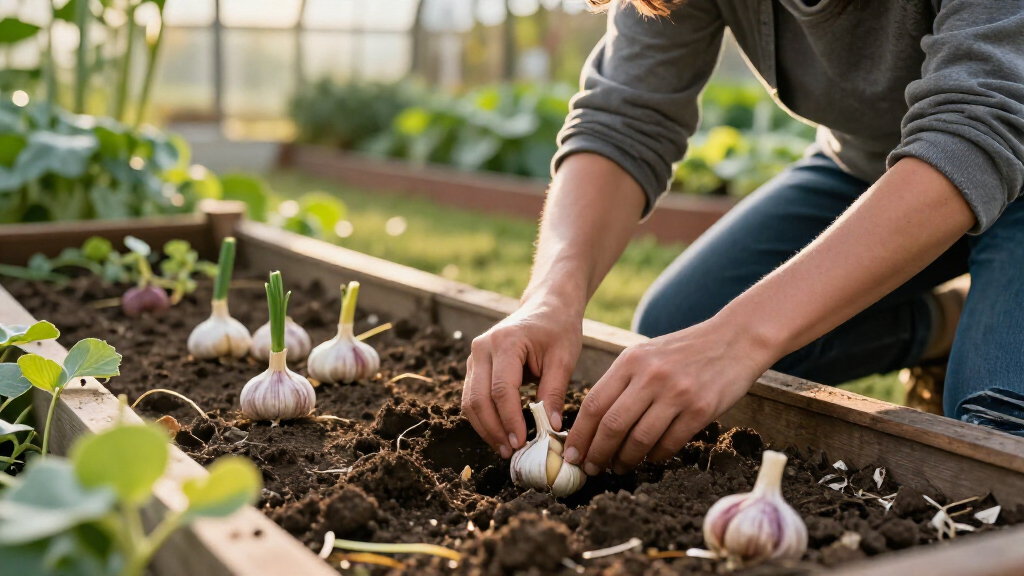
On spacing, Grow Organic recommends planting cloves roughly six inches apart to reduce crowding, with the pointed end up and root end down; garlic planting tools can help make planting more consistent. It says planting depth should follow regional advice; guidance can differ, including whether measurements refer to the clove base or soil above its tip. For the growing season, the guide calls for a sunny, well-drained bed, soil testing before adding amendments, early-season feeding only when needed, weed control and consistent moisture that tapers as harvest approaches.
The Choices That Shape Bulb Size
Grow Organic’s guide presents bulb size as the result of a series of decisions made over many months. It says spacing, planting stock and suitable growing conditions can support healthy growth, while crowded plants or poorly timed care can work against it. That makes the advice relevant to gardeners planning a bed before planting, rather than only those looking for a last-minute fertilizer fix.
The guide also emphasizes limits: a larger starting clove or six-inch spacing cannot guarantee a particular harvest. It identifies soil fertility, drainage, climate and variety as factors that affect results. For gardeners, that means using local growing advice and observing plants through the season are as important as following a general guide.
As an affiliate, we earn on qualifying purchases.
From Fall Planting to Curing
Grow Organic says garlic is commonly planted well before harvest season. Its article says fall planting gives roots time to establish and, in many regions, provides cold exposure needed for normal bulb development. The guide advises gardeners to consult local Extension guidance rather than apply one calendar to every climate. It gives a soil pH range of about 6.0 to 7.0 and recommends adding lime only when a soil test indicates it is needed.
During growth, the article says garlic’s shallow roots make it vulnerable to weeds. Grow Organic notes that mulch can help retain moisture and suppress weeds; in cold climates, straw can also buffer winter temperature changes. For hardneck garlic, the guide recommends cutting a scape once it begins to curl, without removing leaves. Near harvest, it advises checking bulbs as lower leaves brown and several upper leaves remain green, then curing lifted bulbs in shade with good airflow.
As an affiliate, we earn on qualifying purchases.
What the Guide Cannot Guarantee
Grow Organic’s article provides general cultivation advice, not results from a controlled trial or a guarantee of giant bulbs. It does not specify a single garlic variety, location, soil profile or measured yield against which its recommendations were tested. How much each step changes bulb size is therefore not established in the supplied material.
The guide says some instructions require local interpretation. Planting dates and depth vary with climate, and fertilizer needs depend on soil fertility and prior compost use. It recommends following local guidance and soil-test results; it does not provide one fertilizer schedule or irrigation quantity for every garden. Its suggestion to reduce watering near maturity should likewise be adapted to weather and site conditions.
As an affiliate, we earn on qualifying purchases.
Track Conditions Through Harvest
Gardeners applying Grow Organic’s guide can record the variety, planting date, spacing, soil-test results, watering and harvest timing. Such notes can help compare outcomes across seasons without assuming that one year’s bulb size will repeat under different conditions. The guide advises following local Extension recommendations for planting depth and timing, and fertilizer product labels when a soil test indicates feeding is needed.
As plants mature, Grow Organic recommends checking sample bulbs when lower leaves begin to brown. The source advises lifting carefully with a fork and curing bulbs in a shaded, airy place until their necks and wrappers are dry. The article does not report a new harvest result or a follow-up test; whether these practices produce larger bulbs in a particular garden will depend on its conditions and the variety planted.
As an affiliate, we earn on qualifying purchases.
Key Questions
What spacing does the guide recommend for larger garlic bulbs?
Grow Organic suggests starting with about six inches between cloves to limit crowding. It presents this as general guidance, not a guarantee of bulb size.
When should garlic be planted?
Grow Organic favors fall planting where suitable, but says timing depends on local conditions. The guide recommends checking regional Extension advice; it says spring planting can work, though it often yields smaller bulbs.
Should gardeners add extra fertilizer to grow giant garlic?
No. Grow Organic says extra fertilizer alone will not turn a weak crop into jumbo garlic. The guide recommends using a soil test to judge nutrient needs and avoiding excess nitrogen late in growth.
When is garlic ready to harvest?
Grow Organic says to start checking when lower leaves have browned while several upper leaves remain green. The guide suggests lifting a sample bulb to assess whether cloves are full and their wrappers remain intact.
Is elephant garlic a type of true garlic?
No. Grow Organic’s article says elephant garlic is related to leeks, not true garlic (Allium sativum). It has large bulbs and a milder flavor.
Source: rss
Fall yard work Picks
leaf blowers
As an affiliate, we earn on qualifying purchases.