TL;DR

Get garden gear delivered free with Prime
- Fast, free delivery on millions of items
- Prime Video, Amazon Music and more included
- Member-only deals all year
Country Living’s fall gardening report highlights winter rye and crimson clover as cover crops that can protect bare beds and contribute organic matter by spring. Rye is suited to later planting and clover to areas with enough mild weather to establish; local frost timing and seed-packet guidance matter.
Country Living has outlined two fall cover crops—winter rye and crimson clover—for gardeners seeking to protect bare soil and prepare beds for spring. The report says rye can germinate in cold conditions and is a late-season option, while crimson clover is better suited to milder areas where plants have time to establish before frost.
Winter rye is presented as the more flexible choice for late planting. According to Country Living, it can germinate in temperatures as low as 34°F, and its extensive roots can help break up dense clay soil and support soil structure. The report says rye tops may die back in winter while roots continue growing; top growth can resume when temperatures rise.
In spring, the article advises cutting rye before it sets seed, generally when plants reach 12 to 18 inches. Gardeners can turn the cut material into the soil or leave it on the surface as mulch. The report recommends waiting several weeks for the plant matter to decompose before planting the bed.
Crimson clover is described as an option for areas with enough mild weather for establishment. The report says it can add nitrogen and produce red flowers that provide nectar for bees and other pollinators. In spring, it recommends cutting clover to ground level once about half the plants have bloomed, then incorporating the material and allowing a few weeks for decomposition. Seeds may need inoculation with suitable Rhizobium bacteria to support nitrogen fixation, particularly if clover has not been grown in the area recently.
Choosing Cover for Spring Beds
Cover crops give gardeners a way to keep beds from sitting bare through winter. Country Living says a living plant layer can help limit soil loss from winter rain and wind, while cut plant material can add organic matter as it decomposes. The specific benefits depend on the crop and conditions: rye’s roots are highlighted for dense soil, while clover is presented as a nitrogen-contributing option.
Timing affects whether either crop can establish and how soon a bed can be replanted. A crop sown too close to frost may not develop as intended, and spring planting should wait until cut material has had time to break down. These are practical choices for gardeners planning next season’s beds, not a guarantee of a particular soil improvement.
As an affiliate, we earn on qualifying purchases.
Frost Dates Set the Sowing Window
The source report advises gardeners to begin with their local estimated first-frost date, then compare that timing with the seed packet’s germination and growth guidance. It suggests sowing while seedlings still have time to establish before freezing weather. Conditions vary by location, so the article does not give one calendar date that applies to every garden.
For either crop, the report’s basic sowing steps are to remove spent plants and weeds, rake the soil surface, and scatter seed at the rate and depth stated on the packet. Lightly rake or press seeds into contact with the soil, then water. Keep the soil moist until seedlings are established if rainfall does not provide enough moisture.
crimson clover seed for soil nitrogen
As an affiliate, we earn on qualifying purchases.
As an affiliate, we earn on qualifying purchases.
Local Results Will Vary
The report provides general guidance rather than local planting dates or a forecast. It does not identify a specific region, growing zone, or first-frost date, so gardeners must check conditions where they live. The amount of soil improvement, winter survival, and spring growth will also depend on local weather, soil, and establishment.
The article does not give a measured comparison of rye and clover performance or quantify how much nitrogen either cover crop adds. Its recommendations describe potential benefits; they should not be read as guaranteed results. Gardeners should follow the seed packet for sowing rates, depth, and any crop-specific instructions.
cover crop seed inoculant Rhizobium
As an affiliate, we earn on qualifying purchases.
As an affiliate, we earn on qualifying purchases.
Check Seed Guidance Before Sowing
For a bed that is still within its local planting window, the next step is to select a crop suited to the remaining mild weather and prepare the soil according to the seed packet. Gardeners choosing rye for a late sowing should plan to cut it in spring before seed forms. Those planting clover should allow for establishment before winter and monitor flowering so they can cut it at the stage described in the report.
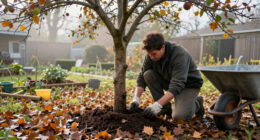
If the window has passed, Country Living suggests covering bare ground with leaf mold, chopped leaves, straw, or another suitable mulch. The article says to keep mulch from touching plant crowns or trunks. It does not provide a single best option for every garden, so the choice depends on available materials and the bed’s needs.
garden soil organic matter amendment
As an affiliate, we earn on qualifying purchases.
As an affiliate, we earn on qualifying purchases.
Key Questions
Which cover crop is better for late planting?
Country Living identifies winter rye as its late-season option, saying it can germinate in temperatures as low as 34°F. Check local frost timing and the seed packet before sowing.
When should winter rye be cut?
The report advises cutting rye in spring before it sets seed, usually when it reaches 12 to 18 inches. The cut plants can be turned into the soil or left as mulch.
Does crimson clover need inoculated seed?
The report says gardeners who have not grown crimson clover in recent years should consider inoculated seed. The bacteria treatment supports the plant’s ability to fix atmospheric nitrogen.
What if it is too late to sow a cover crop?
Country Living recommends covering bare soil with materials such as chopped leaves, leaf mold, or straw, while keeping mulch away from plant crowns and trunks.
Source: rss
Halloween Picks
halloween
As an affiliate, we earn on qualifying purchases.