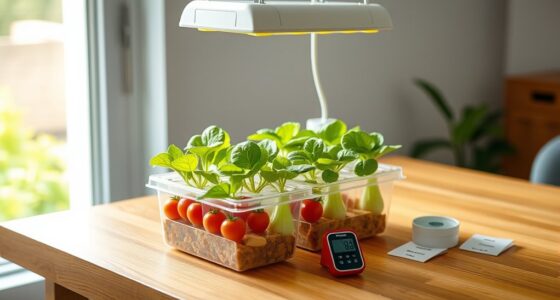
Hydroponic towers need different crop planning because their microclimate, airflow, and light exposure are quite different from countertop units. In towers, the vertical setup influences humidity and pest risk, so selecting suitable crops and managing growth cycles becomes essential. You must also consider nutrient needs and crop rotation carefully to prevent issues. Understanding these differences helps optimize your system’s yield and health. Keep exploring to discover the best strategies for success with your hydroponic towers.

Get garden gear delivered free with Prime
- Fast, free delivery on millions of items
- Prime Video, Amazon Music and more included
- Member-only deals all year
Key Takeaways
- Microclimate variations in towers affect crop suitability and require tailored crop selection and maintenance routines.
- Vertical tower setup improves airflow and light exposure, influencing growth patterns and crop choices.
- Pests and diseases thrive differently in tower environments, necessitating specific management strategies.
- Crop rotation and growth cycles must be optimized for tower space and microclimate, unlike countertop units.
- Nutrient and water management need precise adjustments in towers to prevent plant stress and ensure healthy growth.

Have you ever wondered how to maximize yields from your hydroponic towers? The key lies in understanding that these structures demand a different approach to crop planning compared to countertop units. Unlike traditional soil-based gardening, hydroponic towers are soil-independent, which means you’re not limited by soil quality or composition. This allows you to choose from a broader range of crops, but it also requires careful planning to optimize growth and prevent issues. Since soil isn’t involved, you eliminate many soil-dependent problems, but you can still face challenges like pests and diseases that thrive in moist, nutrient-rich environments. Consequently, pest management becomes a critical aspect of your crop planning. You need to select resistant varieties and establish a regular monitoring routine to catch infestations early. Integrated pest management strategies, such as biological controls and physical barriers, work well in hydroponic systems because they prevent pests from spreading without relying heavily on chemical pesticides, which can disrupt your nutrient solution balance. Additionally, understanding the microclimate within your hydroponic towers can help you tailor your crop choices and maintenance routines more effectively. Another consideration is that hydroponic towers often have a different microclimate compared to countertop units. The vertical setup enhances airflow and light exposure, but it also means you must plan your crop rotation carefully. You’ll want to plant crops with similar growth cycles together to optimize space and avoid overcrowding, which can lead to humidity buildup and increased pest pressure. Also, because these towers are highly efficient in utilizing nutrients and water, you should plan your crop schedule to match their nutrient needs precisely. Over- or under-application can cause stress to plants, making them more susceptible to pests and diseases. Additionally, your crop choices should account for the specific growth requirements of each plant. Unlike countertop units, where small-scale experiments are easier, hydroponic towers often support larger quantities of crops, so planning for succession planting is essential. This approach ensures a continuous harvest and prevents downtime. Since pest and disease management needs to be proactive, selecting crops that are less prone to common pests in hydroponic environments can save you time and resources. Also, diversify your crop selection to prevent monoculture problems, which can lead to rapid pest outbreaks. Incorporating crop diversification strategies can further improve resilience and sustainability in your hydroponic system.
hydroponic tower crop planning guide
As an affiliate, we earn on qualifying purchases.
As an affiliate, we earn on qualifying purchases.
Frequently Asked Questions
How Do Lighting Requirements Differ Between Tower and Countertop Hydroponic Systems?
You’ll find that lighting requirements differ markedly between tower and countertop hydroponic systems. Towers need a broader lighting spectrum to penetrate deeper layers and promote uniform growth, while countertops typically require focused, high-intensity lights. Prioritizing energy efficiency is essential; choosing LED lights with ideal spectrum and low power consumption helps reduce costs and guarantees healthy plant development in both setups.
What Are the Most Suitable Crop Varieties for Hydroponic Towers?
You might think all vegetables thrive equally in hydroponic towers, but the most suitable varieties include leafy greens like lettuce and spinach, and herbs like basil and mint, since they grow quickly and handle vertical setups well. Ironically, crop rotation and pest control are essential here, preventing diseases and pests from spreading in dense, multi-layered environments. These plants optimize space, minimize maintenance, and keep your tower thriving longer.
How Does Nutrient Delivery Vary Between Different Hydroponic Setups?
You’ll notice nutrient delivery varies across hydroponic setups due to differences in nutrient concentration and delivery efficiency. In taller towers, nutrients must be pumped higher, requiring optimized flow rates to guarantee even distribution. Conversely, countertop systems usually have simpler circulation, so nutrient concentration can be closely controlled. Understanding these differences helps you adjust your nutrient solutions appropriately, making sure your plants receive consistent, efficient nourishment regardless of the hydroponic system’s design.
What Maintenance Challenges Are Unique to Hydroponic Towers?
Managing hydroponic towers presents some delicate challenges. You need to vigilantly monitor vertical airflow to prevent issues like mold or pests, ensuring the plants breathe freely. Maintaining root zone stability is essential; uneven water distribution can cause roots to rot or dry out. Regular cleaning of the towers’ components, checking for clogs, and ensuring proper airflow will help sustain healthy growth and prevent unforeseen setbacks.
How Can Pest Management Strategies Differ for Tower Systems?
You should adopt integrated pest control strategies tailored for tower systems, emphasizing biological pest management to minimize chemical use. Because of their vertical structure, pests can spread quickly, so regularly inspecting and introducing beneficial insects can help control infestations effectively. Using biological agents like predatory insects or natural deterrents aligns with tower systems’ eco-friendly approach and keeps your crops healthy without disrupting the delicate hydroponic environment.
As an affiliate, we earn on qualifying purchases.
Conclusion
In planning your hydroponic towers, you must consider the unique needs of each crop, the specific environmental conditions, and the growth cycles. You need to adapt your approach, monitor your plants closely, and adjust your strategies accordingly. You need to be flexible, attentive, and proactive. By understanding these differences, you can optimize your tower’s productivity, guarantee healthy growth, and enjoy a bountiful harvest. In doing so, you turn your tower into a thriving, efficient, and sustainable garden.
hydroponic nutrient solution tester
As an affiliate, we earn on qualifying purchases.
As an affiliate, we earn on qualifying purchases.
vertical hydroponic plant supports
As an affiliate, we earn on qualifying purchases.
As an affiliate, we earn on qualifying purchases.
Halloween Picks
halloween
As an affiliate, we earn on qualifying purchases.