Choosing an automatic garden watering system is less about finding one device for every yard and more about matching how water is delivered to what you grow. Drip irrigation sends water through tubing and emitters to the soil near individual plants; sprinklers spray over a larger area. Both can run from a timer, but they solve different problems.

Get garden gear delivered free with Prime
- Fast, free delivery on millions of items
- Prime Video, Amazon Music and more included
- Member-only deals all year
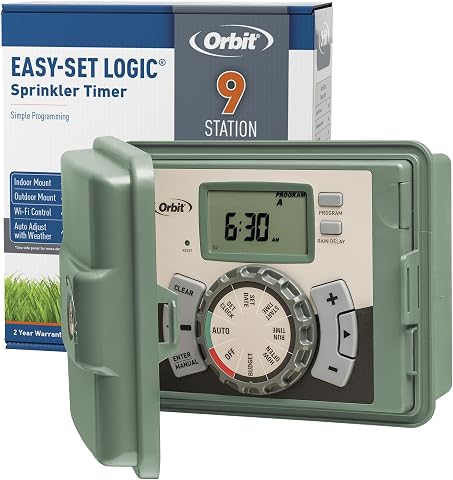
Orbit 57899 9-Station Outdoor Swing Panel Sprinkler System Timer
- ✔ Stations/zones: Up to 12
- ✔ Installation: Indoor or outdoor mounting in a lockable cabinet
- ✔ Control panel: Swing panel with push-wire terminals

Orbit Programmable Digital Hose Watering Timer – 1 Outlet, Battery Powered, LCD Screen, Built-in Rain Delay, Water-Resistant
- ✔ Outlet count: 1
- ✔ Power source: Battery
- ✔ Display: LCD screen

Orbit One Outlet Single-Dial Hose Faucet Timer – Easy Programmable LCD Timer with Adjustable Watering Schedule (Model 62056)
- ✔ Brand: Orbit
- ✔ Outlet count: 1
- ✔ Battery type: AA, non-rechargeable
The real tradeoff is targeted efficiency versus broad coverage. Drip usually makes more sense for vegetable rows, containers, shrubs, and beds where keeping foliage dry and limiting runoff matter. Sprinklers are usually the practical choice for lawns and open areas with plants spaced too closely or irregularly for individual emitters. Drip systems often cost more to plan and install across a large area, while sprinklers can use more water outside the root zone. The comparison below focuses on coverage, water delivery, installation, maintenance, and value so you can choose based on your garden rather than the system’s label.
At a Glance
| Criteria | Automatic drip irrigation system | Automatic sprinkler system | Winner |
|---|---|---|---|
| Best-fit garden | Vegetable beds, containers, trees, shrubs, and defined planting rows | Lawns, broad beds, and open spaces needing wide-area coverage | Depends |
| Water placement and efficiency | Slow delivery near roots; little water lands on paths or leaves when laid out well | Spray can wet paths and foliage; wind and evaporation can reduce efficiency | A |
| Coverage and watering speed | Precise coverage, but each bed or plant zone needs appropriate tubing and emitters | Covers broad areas quickly, subject to nozzle range and overlap | B |
| Installation and layout | Flexible tubing can follow beds; design and emitter placement take planning | Above-ground hoses are simple to deploy; fixed systems need head placement and adjustment | Depends |
| Maintenance | Check for clogged emitters, leaks, and seasonal flushing | Clean or replace clogged nozzles and adjust heads that shift or spray outside the area | Depends |
| Control and expandability | Easy to divide into zones and add lines, though capacity depends on pressure and supply | Timers are common; fixed zones and head placement can limit later changes | Depends |
| Typical value | Often strong value in planted areas where reduced waste matters | Often economical for lawns and large open areas, especially with a simple hose-end timer | Depends |
Orbit 57899 9-Station Outdoor Swing Panel Sprinkler System Timer
For a garden already served by wired sprinkler valves, the Orbit 57899 is the most capable option in this group. It controls up to 12 zones, so separate lawn areas or planting beds can be scheduled independently rather than treated as one hose-connected watering area. That makes it a different class of product from the 62061 and 62056: those timers automate a single faucet outlet, while this controller is intended to run a valve-based system.The swing panel and push-wire terminals are meant to simplify access and connection during installation. Once set up, cycle/soak scheduling can split watering into intervals, a useful way to let water absorb between runs instead of applying one long cycle. Rain delay and overlapping runtimes add flexibility for changing conditions and schedules. The lockable cabinet can be mounted indoors or outdoors, which gives buyers more choice about where to place the controller.That breadth comes with a clear prerequisite: this is not a plug-on timer for a standard garden tap. We need compatible 24 VAC valves and a wired sprinkler installation, and the product information describes capacity of up to 12 zones despite the model name referring to nine stations. Buyers should confirm the exact station configuration and compatibility for their setup before purchasing. The two hose timers are far easier for small gardens with no irrigation wiring; for those buyers, the 57899 adds installation complexity without useful reach. Its upper limit can also be restrictive for larger properties requiring more zones.
Pros:
- Controls up to 12 irrigation zones independently.
- Cycle/soak and rain-delay features provide more scheduling control than the hose timers.
- Swing panel and push-wire terminals are designed to make access and wiring more straightforward.
- Lockable cabinet supports indoor or outdoor mounting and is supplied with two keys.
Cons:
- Requires compatible 24 VAC valves and a wired sprinkler setup; it does not connect directly to a garden faucet.
- The stated maximum of 12 zones may not cover larger or more complex properties.
- More involved to install and configure than either single-outlet hose timer.
Best for: Gardeners with an existing wired sprinkler system, compatible 24 VAC valves, and several areas that need separate schedules.
Not ideal for: Buyers who want to automate a single hose faucet, have no valve-based irrigation installation, or need more than 12 zones.
Bottom line: For buyers with compatible installed sprinklers, the 57899 is the strongest choice here because its multi-zone control and cycle/soak options go well beyond faucet-level automation.
“For buyers with compatible installed sprinklers, the 57899 is the strongest choice here because its multi-zone control and cycle/soak options go well beyond faucet-level automation.”
Orbit Programmable Digital Hose Watering Timer – 1 Outlet, Battery Powered, LCD Screen, Built-in Rain Delay, Water-Resistant
For a garden watered from an outdoor tap, the Orbit 62061 provides the most clearly specified balance of scheduling and everyday simplicity. Its LCD interface lets us set watering duration and frequency, while the built-in rain delay can pause the schedule for 24, 48, or 72 hours. That adjustable pause is useful when rain makes a scheduled run unnecessary, without requiring us to abandon the normal program. Unlike the 57899, it needs no sprinkler-valve network; it attaches to a faucet and automates one connected watering line.Compared with the 62056, the 62061’s strongest distinction is the explicit choice of three rain-delay periods and its stated water-resistant construction. Both are one-outlet, battery-powered Orbit timers with LCD scheduling and a six-year limited warranty, so the practical decision is less about broad capability than about which control details suit the way we manage watering. The 62056 emphasizes its large display and single-dial programming; the 62061 makes its adjustable delay options particularly easy to evaluate.Its limits are just as important. One outlet means one connected line, so it cannot independently control multiple hoses or irrigation zones. Battery operation also means keeping an eye on power and replacing or recharging batteries as needed; it does not provide the multi-zone reach of a wired panel controller. We would choose it for raised beds, a small lawn, or containers served by one faucet, but skip it if our garden needs separately timed areas or already has a compatible sprinkler-valve system.
Pros:
- LCD interface supports straightforward programming of watering duration and frequency.
- Selectable 24-, 48-, and 72-hour rain delays offer useful control after wet weather.
- Water-resistant construction is intended for outdoor faucet use.
- Six-year limited warranty provides a defined coverage period.
Cons:
- A single outlet cannot run multiple watering lines as separate schedules.
- Battery power requires periodic replacement or recharging.
- Does not offer the multi-zone valve control of the 57899.
Best for: Gardeners who water one hose-connected area and want clear digital scheduling plus a selectable rain pause.
Not ideal for: Owners of multi-zone sprinkler installations or anyone who needs to operate more than one faucet outlet independently.
Bottom line: The 62061 is our best all-around faucet timer when one outlet is enough and an adjustable rain delay matters more than multi-zone control.
“The 62061 is our best all-around faucet timer when one outlet is enough and an adjustable rain delay matters more than multi-zone control.”
Orbit One Outlet Single-Dial Hose Faucet Timer – Easy Programmable LCD Timer with Adjustable Watering Schedule (Model 62056)
The Orbit 62056 is for buyers who want a digital faucet timer without learning a more involved control layout. Its large LCD and single-dial programming approach put schedule adjustments front and center. We can set start time, duration, and frequency, then use the rain-delay feature to avoid an unnecessary watering cycle after rainfall. Like the 62061, it converts one standard outdoor faucet into an automated watering point, making it a practical step up from remembering each watering by hand.Its appeal is primarily the dial-led interface, not greater irrigation capacity. The 62061 offers a more explicitly detailed 24-, 48-, or 72-hour rain delay and calls out water-resistant construction, whereas the 62056 foregrounds its large display, adjustable schedule, and brass swivel connection. Neither replaces the other in a dramatic way: both serve one line, rely on batteries, and include a six-year limited warranty. Buyers should compare the controls and connection details that matter to their setup rather than assume this model can manage multiple parts of a garden.The single-outlet design is the key compromise. If we need to water separate beds on different schedules, this timer cannot control them independently; a second setup or a multi-zone valve controller such as the 57899 is a better fit. But the 57899 also demands compatible valves and a wired installation, so it is not a like-for-like upgrade for a simple hose garden. The 62056 makes the most sense when a faucet connection, easy schedule changes, and a straightforward interface matter more than extensive automation.
Pros:
- Large LCD and single-dial programming make schedule setting approachable.
- Start time, watering duration, and frequency are adjustable.
- Rain-delay feature can pause scheduled watering after rain.
- Brass swivel connection and six-year limited warranty are useful durability details.
Cons:
- One outlet limits the timer to a single connected watering line.
- Requires non-rechargeable AA batteries.
- Its feature set does not provide the 57899’s multi-zone sprinkler control.
Best for: Gardeners who want an easy-to-adjust digital schedule for one hose-connected watering area and prefer dial-based controls.
Not ideal for: Buyers who need multiple outlets or separately controlled zones, or who want a valve-based sprinkler controller.
Bottom line: Choose the 62056 when simple dial-based operation is the priority, but favor the 62061 if its specified rain-delay choices better match your watering routine.
“Choose the 62056 when simple dial-based operation is the priority, but favor the 62061 if its specified rain-delay choices better match your watering routine.”
As an Amazon Associate we earn from qualifying purchases.
Key Differences
The main difference is where the water goes. Drip irrigation applies it close to roots, making it easier to water planted areas without soaking paths or spraying leaves. That precision can reduce waste, but only when emitters are placed to match the plants and the system has enough pressure to deliver consistent flow. Sprinklers cover ground instead of individual root zones. That broad pattern is useful for grass, but it can send water beyond the plants, especially where beds have irregular edges or wind carries the spray.
Convenience also depends on the shape of the garden. A sprinkler can cover a lawn with relatively few watering points, while a drip layout may need separate lines, emitters, and zones for beds with different needs. In a small vegetable garden, that extra layout work can pay off in controlled watering. In a large lawn, installing enough drip line to cover the ground would be impractical. Neither method automatically produces a better garden: scheduling, local weather, soil, pressure, and maintenance all affect results. The better choice is the one that applies water evenly to the areas you actually need to irrigate.
For many properties, using both is more sensible than forcing one method to do every job. Drip can handle beds, trees, and containers while sprinklers serve the lawn. If you are buying only one system, choose based on the largest or most water-sensitive area you need to maintain. Pay extra for automation or a more elaborate layout only when it delivers control you will use, such as separate schedules for sunny beds and shaded ones.
Detailed Comparison
Best-fit garden and coverage (major difference)
Drip wins for defined planting areas; sprinklers win for lawns and open ground. This is a major difference because the delivery patterns are designed for different shapes of garden. Drip tubing can run alongside vegetable rows, containers, and shrubs, supplying water near those plants without needing to wet all the soil between them. Sprinklers are better at covering a continuous surface such as turf, where water needs to reach many plants across a broad area.
For a mixed yard, use the system that suits the area it serves rather than expecting one layout to fit everything. A sprinkler can water a bed, but may spray paths and foliage. A drip line can irrigate a lawn, but covering turf evenly would require extensive tubing and careful spacing.
Water placement and efficiency (Automatic drip irrigation system wins — major)
Drip usually wins for water placement, with a moderate-to-major practical advantage in planted beds. Emitters release water near the root area, so less is directed onto pavement or carried away by wind. This can be especially useful in dry climates, on sloped beds, or where plants are spaced apart. It does not make a system waste-proof: leaks, poor emitter spacing, unsuitable run times, or blocked lines can still lead to under- or overwatering.
Sprinklers can be effective when properly matched to an open area and run under suitable conditions. Their spray is more exposed to wind and evaporation, and the pattern may wet leaves and nearby surfaces. Choose drip if water conservation and targeted watering are leading concerns; for a lawn, even coverage may matter more than pinpoint delivery.
Coverage speed and uniformity (Automatic sprinkler system wins — major)
Sprinklers win for quickly covering broad areas, a major advantage for lawns. A well-positioned sprinkler can water a large patch in one cycle, with heads or units arranged to overlap where needed. The coverage still depends on water pressure, nozzle range, wind, and placement; a sprinkler does not guarantee uniform watering simply because it reaches a wide area.
Drip irrigation delivers water more slowly and locally. That is a benefit for many beds, but a disadvantage if you need to irrigate extensive turf. Each planting zone needs lines and emitters placed where water is needed, and the system may take longer to lay out or expand. For lawns, sprinklers are the clear fit. For planted rows, the wider spray is not a meaningful benefit if it also waters unwanted areas.
Installation and layout (moderate difference)
Neither wins in every garden; the gap is moderate and depends on whether the system is temporary or fixed. A basic hose-end sprinkler and timer can be quick to set up, but getting full, even coverage may require repositioning or multiple sprinklers. A permanent sprinkler layout involves selecting head locations and zones, which can make installation more involved.
Drip lines are easy to route through a defined bed, but planning the line paths, emitter spacing, and watering zones takes care. A small vegetable patch may be straightforward; a sprawling garden with many plant types can require substantial tubing and adjustment. If you want a system that can be changed as beds move, surface drip tubing is often adaptable. If you need a permanent lawn layout, a fixed sprinkler system can be tidier once installed.
Maintenance and reliability (minor difference)
This is a close comparison because each system has different failure points. Drip emitters and narrow tubing can clog, especially if water carries sediment or the system is not flushed as needed. A blockage may go unnoticed until a plant shows signs of stress, so checking flow along the line matters. Filters and accessible connections can make routine checks easier.
Sprinkler nozzles can also clog, and heads may shift, leak, or spray onto paths and buildings. Their problems are often visible while running, but a partly blocked nozzle can leave dry patches. Drip is easier to inspect along an accessible bed; sprinklers are easier to observe across open turf. Neither is maintenance-free, so the better option depends on which kind of inspection suits your property.
Automation and zoning (moderate difference)
There is no universal winner; both can run on timers, and the advantage is moderate when different areas need different schedules. A timer can automate a simple sprinkler or drip setup, but automation does not correct poor coverage or an unsuitable schedule. More advanced controllers may offer separate zones or weather-based adjustments, though compatibility and features vary by product.
Drip systems are often divided by bed or plant group, which makes it practical to give a vegetable patch and established shrubs different run times. Sprinkler systems can also use zones, particularly in fixed installations, but an existing lawn layout may be less flexible if heads and pipes are already set. Before paying for a smart controller, check that it works with the valves, timer, and water supply you plan to use.
Cost and value (moderate difference)
Value depends on the area being watered, rather than one system being cheaper in every case. A simple sprinkler with a timer can be an economical solution for a lawn or open patch. For a large area, a permanent sprinkler installation can add equipment and labor costs. Drip tubing may be inexpensive for a compact bed, but lines, emitters, filters, fittings, and zone controls add up as the planted area grows.
Drip can justify extra setup cost where targeted watering avoids regularly wetting paths or broad unplanted areas. Sprinklers offer better value where broad coverage is the actual need. Paying more for a controller makes sense if separate schedules or automatic adjustments solve a real problem; it is poor value if a basic timer already fits your routine.
Automatic drip irrigation system: Pros and Cons
Pros:
- Targets water near plant roots in beds and rows
- Can limit spray onto paths and foliage
- Flexible tubing suits containers, shrubs, and changing beds
- Useful for separate watering zones
Cons:
- Emitters and tubing may clog and need inspection
- Requires thoughtful line and emitter placement
- Slow, local delivery is a poor match for large areas of lawn
- A complex garden can require substantial tubing and setup
Automatic sprinkler system: Pros and Cons
Pros:
- Covers lawns and open areas quickly
- A basic hose-end setup can be simple to deploy
- Broad spray suits continuous ground cover
- Spray patterns can be checked visually while running
Cons:
- Wind and evaporation can reduce the amount reaching the soil
- May wet paths, foliage, or areas outside the garden
- Nozzles and heads can clog, shift, or develop leaks
- Less targeted for widely spaced plants or irregular beds
Who Should Choose What
Choose Automatic drip irrigation system if:
- You mainly water vegetable beds, containers, shrubs, trees, or defined planting rows.
- You want to apply water near roots and reduce watering of paths or bare ground.
- Your plants have different needs and separate watering zones would help.
- You are willing to check lines and emitters as part of seasonal upkeep.
Choose Automatic sprinkler system if:
- Your main watering job is a lawn or another broad, open area.
- You want wide coverage without routing tubing to each planting row.
- A simple hose-end sprinkler and timer would cover the area adequately.
- You can position the system to limit overspray and check for dry patches.
Skip both if: If your area is too small to justify an automatic setup, or local watering rules and water supply make automated irrigation unsuitable, use a watering can or hose when needed and follow local restrictions.
Value for Money
Paying more is worthwhile only when it buys a better match for the garden. Drip irrigation can be the better value for planted beds because targeted delivery may avoid repeatedly watering paths and unused ground. That does not mean every drip kit saves money: a large or complicated layout can require many fittings, lines, and emitters. A basic sprinkler and timer can be cheaper and more useful for a lawn, where broad coverage is the point.
Spend on a timer when you need regular unattended watering; consider separate zones if different areas need different schedules. More advanced controls are worth the added cost for users who will use their scheduling or weather features, but they cannot compensate for misplaced emitters or poorly adjusted sprinkler heads. For mixed yards, a modest drip setup for beds plus a separate sprinkler for turf often delivers better practical value than buying one oversized system to handle both jobs.
Final Verdict
Choose an automatic drip irrigation system if your priority is a vegetable garden, planted beds, containers, trees, or shrubs. Its strongest advantage is targeted delivery, and that is usually worth the added layout work where plants occupy defined spaces. Choose an automatic sprinkler system if you mainly need to water a lawn or another broad, continuous area; it covers that ground more practically and often at lower setup cost.
The biggest deciding factor is the shape of the area you need to water: beds favor drip, while turf favors sprinklers. For a yard with both, use each system for the job it handles well if your budget and water supply allow it. Do not pay extra for advanced automation unless you need separate schedules or features beyond a basic timer. If you can buy only one, pick the system that serves the largest area you water regularly—not the one with the most features.
Frequently Asked Questions
Is drip irrigation better than a sprinkler for a vegetable garden?
Usually, yes. Drip lines can deliver water near vegetable roots without routinely spraying leaves or paths. They still need suitable emitter spacing and regular checks for blockages. A sprinkler may be simpler for a small, densely planted patch if its spray reaches the bed evenly without wasting water outside it.
Can one automatic system water a lawn and garden beds?
It can, but the best arrangement often uses separate zones or separate systems. Lawns generally need broad sprinkler coverage, while beds benefit from targeted drip lines. Combining them under a single schedule can be inconvenient if the lawn and plants need different watering times or amounts.
Which system uses less water?
Drip irrigation often uses water more precisely in planted beds because it directs flow near roots. Actual use depends on system condition, layout, pressure, run time, soil, and weather. A sprinkler can still be used efficiently on a lawn when it is adjusted for even coverage and run at suitable times.
Is an automatic garden watering system worth the cost?
It can be worthwhile if you water regularly, have areas that dry out when you are away, or want a consistent routine. A basic timer may be enough for a small garden. A more expensive controller makes sense only if its extra scheduling or adjustment features meet a specific need.
Halloween Picks
halloween
As an affiliate, we earn on qualifying purchases.