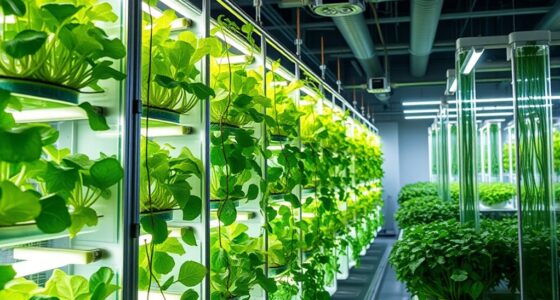
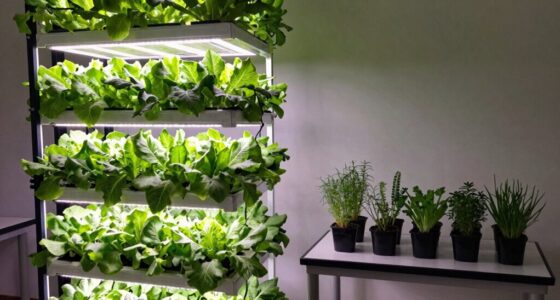
A grow rack makes more sense than a tower when you’re working with limited space and need easy access to your plants. It’s ideal if you want to maximize vertical stacking without sacrificing convenience for watering, pruning, or harvesting. Rack systems are more practical for small grow setups where space efficiency and accessibility are top priorities. To learn more about when to choose a grow rack over a tower, keep exploring the key differences and benefits.

Get garden gear delivered free with Prime
- Fast, free delivery on millions of items
- Prime Video, Amazon Music and more included
- Member-only deals all year
Key Takeaways
- Use a grow rack when space is limited and vertical stacking maximizes your available area effectively.
- Choose a grow rack if you need easier access and maintenance compared to reaching into tower setups.
- Opt for a grow rack when uniform light distribution and energy efficiency are priorities for your grow environment.
- Select a grow rack if you want scalable, customizable tiers suited for small or confined grow spaces.
- Consider a tower only if horizontal space is ample and you prefer a more traditional, single-tier growth setup.

Deciding between a grow rack and a tower depends on your specific growing needs and space constraints. If you’re working with limited space but want to maximize your plant output, a grow rack might be the smarter choice. Grow racks are designed to stack multiple levels vertically, which allows you to optimize your available space efficiently. This vertical stacking enhances space optimization, making it easier to fit a larger number of plants into a compact area. Plus, with a grow rack, you can often customize the number of tiers, giving you control over how many plants you grow at once.
Grow racks maximize space with vertical stacking, allowing more plants in limited areas and customizable tiers for efficient growing.
Lighting efficiency is another key factor to ponder. Grow racks are generally easier to light uniformly because their multiple levels can be arranged to ensure each plant receives adequate light. You can position grow lights to cover each tier evenly, reducing shadows and promoting consistent growth. This setup makes it simpler to manage light distribution, especially when using LED grow lights, which are energy-efficient and provide targeted illumination. In contrast, towers tend to be more limited in this regard, often requiring more complex lighting arrangements to ensure all plants get enough light, which can lead to energy wastage.
Your available space plays a big role in deciding which setup works best. If your growing area is narrow or restricted in width, a grow rack’s compact, multi-tier design allows you to make full use of vertical space without sprawling outward. This setup is ideal for small grow rooms or closets where horizontal space is at a premium. Additionally, grow racks often incorporate vertical stacking options that maximize efficiency in small areas. Understanding the space-saving benefits of vertical gardening can help you optimize your grow environment more effectively. Moreover, considering scalability is important for future expansion or increased plant capacity. As the demand for sustainable practices increases, employing efficient space utilization can contribute to more sustainable growing methods.
Ease of access is another consideration. Grow racks often come with shelves or pull-out trays, making it easier to tend to your plants without disturbing others. This setup simplifies watering, pruning, and harvesting, saving you time and effort. Towers, especially taller ones, might require you to climb or stretch to reach the upper plants, which can be inconvenient and potentially unsafe.
Ultimately, if your goal is to maximize productivity within a limited footprint and take into account lighting efficiency, a grow rack makes more sense. It offers better space optimization, easier lighting management, and convenient access, all of which streamline your growing process. If you have ample horizontal space and prefer a less layered approach, then a tower might suit your needs better. But for most tight spaces and those looking to optimize every inch, a grow rack is the practical, efficient choice.
Products Worth Considering

IDEALHOUSE 6 x 9 ft Polycarbonate Greenhouse with Lockable Door, Adjustable Roof Vent, and Gutters

VEVOR Walk-In Tunnel Greenhouse with Watering System, 15 x 7 x 7 ft

Greenworks 80V Cordless Axial Leaf Blower Kit with 4Ah Battery and Charger
As an affiliate, we earn on qualifying purchases.
Frequently Asked Questions
What Types of Plants Thrive Better on Grow Racks Versus Towers?
You’ll find that leafy greens, herbs, and small vegetables thrive better on grow racks, especially in vertical farming setups, as they benefit from better airflow and easy pest control management. Towers are great for taller plants like tomatoes or peppers. Grow racks help optimize space and reduce pest issues, making them ideal for plants that need frequent airflow and easier access. Choose based on plant height and pest control needs.
How Does Space Layout Influence the Choice Between a Grow Rack and Tower?
Your space layout plays a vital role in choosing between a grow rack and a tower. If vertical expansion is limited, a grow rack offers better space optimization by utilizing wall or ceiling height efficiently. On the other hand, towers work well in tight, narrow spaces where vertical growth is restricted. Consider your available area’s shape and height to make certain your plants grow comfortably without crowding.
Are There Specific Lighting Requirements Unique to Grow Racks?
Think of your grow setup as a symphony; proper lighting is essential. Grow racks often need specific lighting installation, such as adjustable LED fixtures, to ensure even coverage. You also need to contemplate power requirements, as racks typically demand more energy for multiple light sources. Opt for high-quality grow lights with the right spectrum, and ensure your electrical system can handle the load to keep your plants thriving.
What Are the Cost Differences Between Setting up a Grow Rack and a Tower?
A grow rack typically costs more upfront due to its setup complexity, including sturdy shelving and specialized lighting, but it offers better organization and airflow. A tower is usually cheaper initially, with simpler assembly and fewer materials. Your cost analysis should consider long-term benefits versus initial expenses. If you prioritize efficient space utilization and scalability, a grow rack might be a smarter investment despite the higher setup costs.
How Do Maintenance Needs Compare Between Grow Racks and Towers?
A stitch in time saves nine, and when it comes to maintenance, grow racks often require less effort than towers. With hydroponic systems, you’ll find that grow racks are easier to access for pest management and routine cleaning, reducing overall upkeep. Towers might need more frequent attention due to their compact design, but racks’ open structure makes monitoring and maintenance straightforward, saving you time and effort in the long run.
Conclusion
Ultimately, choosing between a grow rack and a tower is like picking the right tool for a job—you want precision and efficiency. When your plants need space to breathe, and your setup feels cramped, a grow rack opens up the sky for your greenery to flourish. Think of it as upgrading from a cozy nest to a sprawling garden. Trust your instincts; your plants will thank you with lush, vibrant growth, turning your space into a thriving oasis.