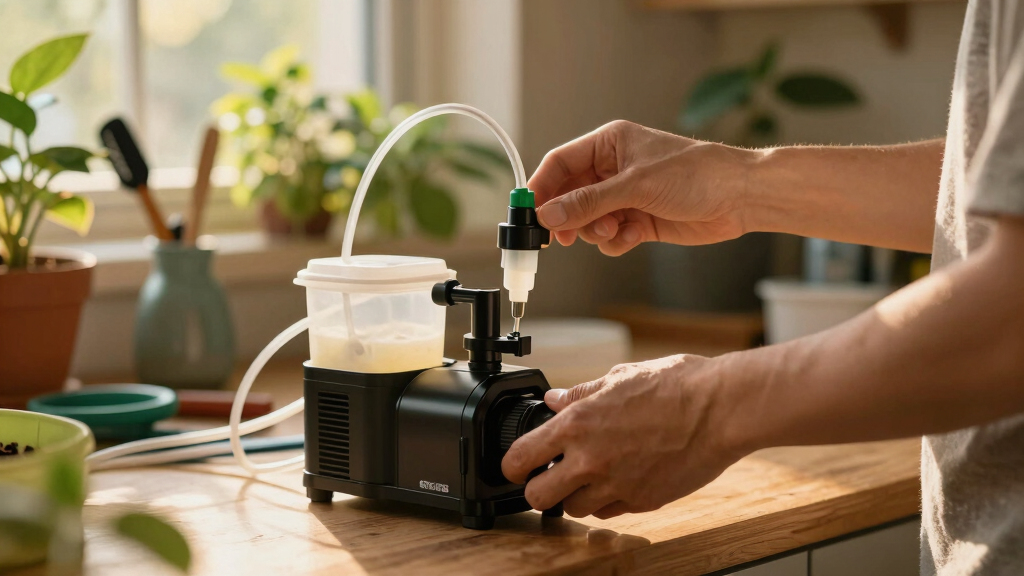

Finding the best hydroponic dosing pump system involves balancing precision, reliability, and ease of use. The HUIOP Timed Dosing Peristaltic Pump stands out for its accurate timing and adjustable flow, making it ideal for controlled nutrient delivery. The Milwaukee Instruments MC720 offers high precision suited for larger setups, while the AC Infinity Peristaltic Pump provides customizable dosing levels for versatile applications. Buyers face tradeoffs between affordability, flow rate, and control features. Continue reading for a detailed breakdown of these options and what makes each suitable for different needs.

Get garden gear delivered free with Prime
- Fast, free delivery on millions of items
- Prime Video, Amazon Music and more included
- Member-only deals all year
Complete the kit


Key Takeaways
- Top picks balance flow rate, control precision, and ease of maintenance, with no one-size-fits-all solution.
- Peristaltic pumps generally offer better durability and chemical compatibility for hydroponics compared to diaphragm models.
- Adjustability and programmability are key features that separate premium systems from basic models.
- Price often correlates with features like flow rate, control options, and build quality—higher cost usually means more versatility.
- For small-scale or beginner growers, simpler, more affordable pumps deliver reliable performance without complexity.


| hydroponic dosing pump system | Flow Rate |
|---|---|
| HUIOP Timed Dosing Peristaltic | 160ml/min |
| Milwaukee Instruments MC720 Do | — |
| Diaphragm Metering Pump for Ch | 30 GPD (4.72 LPH) |
| Automatic pH Controller with D | — |
| NEWTRY Fertilizer Injector for | — |
| Kamoer KCPA600 24V Peristaltic | 180-520ml/min |
| AC Infinity Peristaltic Dosing | up to 210 mL/min |
| Kamoer M1-STP Intelligent Peri | — |
| Stenner 45MHP10 Pump Adjustabl | 10 GPD |
More Details on Our Top Picks
HUIOP Timed Dosing Peristaltic Pump with 5 Meter Hose, 160ml/min
This peristaltic pump stands out for its accurate digital controls and quiet operation, making it ideal for home or office hydroponic setups. Compared to the Kamoer M1-STP, it offers more features like intelligent modes and a removable pump head, but its fixed flow rate of 160ml/min can be limiting for larger systems. Its self-locking and memory functions improve reliability, yet complex setup might challenge beginners. This pick makes the most sense for growers needing precise, low-volume dosing without frequent maintenance.
Pros:- Accurate dosing with digital controls
- Easy to maintain with removable pump head
- Low noise operation
Cons:- Limited to a flow rate of 160ml/min
- Requires a power source, not battery operated
Best for: Home gardeners or small-scale hydroponic enthusiasts who prioritize accuracy and ease of maintenance
Not ideal for: Large commercial growers requiring higher flow rates, as this pump is limited to 160ml/min and more complex for beginners
- Flow Rate:160ml/min
- Hose Length:5 meters
- Modes:Manual and Intelligent
- Features:Self-locking, memory function, removable pump head
Our verdict“Best suited for small-scale users needing precise, quiet dosing with straightforward maintenance.”
Milwaukee Instruments MC720 Dosing Pump Kit
This kit excels in maintaining stable pH levels by integrating a dedicated pH controller with a small, precise dosing pump. Compared with the HUIOP, the Milwaukee MC720 prioritizes automation over manual adjustments, making it ideal for consistent nutrient or pH control in hydroponics. Calibration and setup require some familiarity, but once dialed in, it offers reliable, hands-off operation for pH balancing. It’s best for growers who want to automate pH correction without monitoring constantly.
Pros:- Automated pH control for consistent system health
- Precise, small flow dosing for pH adjustments
- Easy to set pH range from 5.5 to 9.5
Cons:- Requires calibration and setup, not plug-and-play
- Limited to pH and fertilization applications
Best for: Hydroponic growers focused on maintaining optimal pH levels with minimal manual intervention
Not ideal for: Growers seeking large flow rates or multi-parameter control, as its primary function is pH regulation and small dosing
- Brand:Milwaukee Instruments
- Model Number:43217-86566
- Number of Packs:1
- Unit Count:1
- Specific Uses:Hydroponic Systems, Fertilization Mixing Tanks
Our verdict“Ideal for users who want reliable, automated pH management in their hydroponic systems.”
Diaphragm Metering Pump for Chemical Laboratory Dosing, 30 GPD (4.72 LPH), 100 PSI, PVC Liquid End with Ceramic Ball Valves, Includes Tubing
This diaphragm metering pump offers excellent control for chemical dosing, surpassing the simpler HUIOP with its adjustable flow up to 30 GPD and high pressure capacity. Compared to the Milwaukee pH pump, it provides more robust construction for chemical applications, but it’s less suited for small-scale or hobbyist hydroponics due to its industrial design and indoor-only use. Its complete accessory kit and modular design make maintenance straightforward, yet its higher complexity can intimidate newcomers. It’s best for users needing durable, pressurized chemical dosing in laboratory or industrial contexts.
Pros:- Precise, adjustable chemical dosing
- Durable PVC construction with ceramic valves
- Complete kit with accessories included
- Suitable for high-pressure systems up to 100 PSI
Cons:- Designed primarily for indoor, industrial use
- Not suitable for flammable liquids or large-scale agriculture
Not ideal for: Small-scale growers or hobbyists, as it’s designed for pressurized, industrial use and not suitable for simple hydroponic setups
- Flow Rate:30 GPD (4.72 LPH)
- Maximum Pressure:100 PSI
- Liquid End Material:PVC
- Flow Adjustment:Yes
- Includes:Suction & Discharge Tubing, Strainer, Bleed Valve, Check Valve, Injection Fitting
- Ports:3/8″
Our verdict“Best for industrial or laboratory applications requiring reliable, pressurized chemical dosing, not casual hydroponics.”
Automatic pH Controller with Dosing Pump & Dual Relay Output for Aquariums and Hydroponics
This digital pH controller combines dosing capabilities with trend analysis features, making it suitable for both aquariums and hydroponic nutrient solutions. Compared with the Milwaukee kit, it offers more comprehensive data monitoring and dual relay outputs for multiple dosing channels. However, its setup can be complex for beginners, and it’s primarily tailored to specific applications rather than flexible general use. High-precision sensors and ATC function translate to accurate pH regulation even with temperature fluctuations. It’s perfect for growers who want detailed control and data tracking.
Pros:- Automates pH regulation with dual dosing channels
- Includes data trend charts for informed adjustments
- High-precision sensor with temperature compensation
Cons:- Setup process may be difficult for novices
- Limited to applications like aquariums and hydroponics
Best for: Hydroponic or aquatic growers seeking automated, data-driven pH management and system monitoring
Not ideal for: Users new to automation or those with simple hydroponic systems, due to its complex setup and specialized features
- Dosing Pumps:Included
- Dual Relay Output:Yes
- Data Chart Display:Yes
- ATC (Automatic Temperature Compensation):Yes
- Functions:MAX/MIN/AVG, Dose Count
Our verdict“Best for advanced growers who want detailed control and monitoring of pH and nutrient levels.”
NEWTRY Fertilizer Injector for Drip Irrigation, 0.1%-0.9% Dosing Pump
This water-powered fertilizer injector offers a simple, reliable solution for drip irrigation, with adjustable dosing from 0.1% to 0.9%. Compared with electronic pumps like the Milwaukee or HUIOP, it operates solely on water flow, eliminating electricity needs. Its universal connection and pressure support make it versatile for various systems, but the flow rate can decrease when passing through the injector, and it requires consistent water pressure for optimal performance. This device is best suited for growers who prefer a straightforward, maintenance-free approach to fertilization in outdoor or large-scale irrigation setups.
Pros:- Adjustable dosing for precise nutrient delivery
- Water-powered operation eliminates electricity dependency
- Universal connection fits most systems
- Reliable performance with varying water pressures
Cons:- Flow rate may decrease passing through the injector
- Requires compatible water pressure and flow for best results
Not ideal for: Growers needing precise, small-volume dosing or electronic control, as flow consistency may vary with water pressure
Our verdict“Ideal for outdoor or large-scale irrigation where simplicity and water-powered operation are prioritized over fine control.”
Kamoer KCPA600 24V Peristaltic Pump High Flow Rate Liquid Dosing Pump 180-520ml/min Adjustable, Norprene Tube 4mm ID x 7.2mm OD
The Kamoer KCPA600 stands out for its adjustable flow rate, offering a broad range from 180 to 520 ml/min, making it suitable for larger or more demanding hydroponic systems. Compared with the AC Infinity pump, it excels in high-volume applications but lacks WiFi control, which might limit smart integration. Its durable Norprene tubing ensures long-term chemical resistance, yet the manual adjustment process means less automation and more user intervention. The noise level could be a concern in quiet grow rooms, but its straightforward maintenance makes it ideal for those who prioritize reliability and high capacity. This pump is best suited for growers needing flexible, high-flow dosing without complex automation.
Pros:- Adjustable flow rate up to 520 ml/min for versatile applications
- Robust Norprene tube resists chemicals and UV exposure
- Simple manual speed adjustment and easy tube replacement
Cons:- Supports only manual adjustment, no automated control
- Flow rate adjustment requires manual intervention, limiting automation
- Noise level could be disruptive in quiet environments
Best for: Large-scale hydroponic setups requiring high flow rates and manual control
Not ideal for: Small indoor gardens or growers seeking fully automated, WiFi-enabled systems
- Voltage:24V
- Current:1A
- Power:<24W
- Max Speed:400rpm
- Flow Rate:180-520ml/min
- Tube Material:Norprene
- Tube Size:4mm ID x 7.2mm OD
Our verdict“Best suited for users who need high-volume, manual dosing with durable components.”
AC Infinity Peristaltic Dosing Pump, Precise 10-Level Liquid Dosing Control
The AC Infinity pump offers precise dosing with 10 adjustable levels, making it ideal for fine-tuned nutrient delivery in hydroponics, aquariums, or lab environments. Its standout feature is WiFi app control, which allows for seamless programming and automation—something the Kamoer M1-STP lacks. While it provides up to 210 mL/min flow, its control relies heavily on the compatibility of smart controllers, which might limit use without proper setup. It operates quietly and efficiently, making it suitable for discreet environments. However, it’s best for users comfortable with smart system integration and with applications needing accurate, multi-level dosing.
Pros:- Precise 10-level control for fine-tuned dosing
- Quiet, energy-efficient operation
- WiFi app control enables easy programming and automation
Cons:- Requires compatible controllers for full functionality
- Limited to specific applications like hydroponics and aquariums
Best for: Hydroponic growers seeking smart, automated control with precise dosing capabilities
Not ideal for: Growers without WiFi or smart controller integration needing simple, standalone pumps
- Flow Rate:up to 210 mL/min
- Dosing Levels:10
- Interval Control:seconds
- Compatibility:AI and UIS controllers
- Motor:DC motor
- Application:hydroponics, aquariums, labs
Our verdict“Ideal for growers wanting integrated, app-controlled dosing with precise, multi-level adjustment.”
Kamoer M1-STP Intelligent Peristaltic Pump 24V 0-88ml/min Low Flow
The Kamoer M1-STP is tailored for precise, low-volume liquid transfer, supporting flow rates up to 88 ml/min. Its programmable modes and flow calibration make it stand out for applications like nutrient dosing in small hydroponic systems, where accuracy is critical. Compared to the higher-flow Kamoer KCPA600, it offers more detailed control for delicate dosing tasks but isn’t suitable for high-volume needs. Its compact size and multiple control options, including RS485 and foot-switch, provide flexible integration. However, its limited flow range and dependence on external tubing mean it’s not ideal for high-capacity systems or those needing automation without additional controllers.
Pros:- Supports multiple dosing modes with adjustable parameters
- Built-in flow calibration for high accuracy
- Compact, lightweight design for easy integration
Cons:- Limited to low flow applications up to 88 ml/min
- Requires compatible tubing for proper liquid contact
- No battery operation; relies on external power
Best for: Growers needing precise, low-flow nutrient dosing in small or delicate systems
Not ideal for: Large-scale hydroponic setups or high-volume nutrient transfer applications
- Flow Range:0-88 ml/min
- Voltage:24V
- Weight:510 g
- Temperature Range:0-60 °C
- Humidity:below 80% non-condensing
Our verdict“Perfect for users who need highly accurate, low-flow dosing in small-scale or sensitive hydroponic systems.”
Stenner 45MHP10 Pump Adjustable 100 psi 10 GPD 120V/60Hz 1/4 Inch
The Stenner 45MHP10 excels in delivering consistent, high-pressure dosing, capable of operating at up to 100 psi with a flow of 10 GPD. Its gear-driven motor and self-priming features provide reliability in larger or pressurized systems, although the 1/4 inch connection limits its use in smaller, more delicate setups. Compared to electric pumps like the Kamoer KCPA600, it offers less flow flexibility but is better suited for steady, high-volume applications where pressure and reliability matter most. Its adjustable output allows for a degree of precision, though it’s not designed for fine-tuned nutrient dosing in small systems.
Pros:- Adjustable output for reliable, high-pressure flow
- Self-priming and automatic degassing features
- Gear-driven motor offers durability
Cons:- Limited connection size restricts use in small systems
- Flow rate may not meet high-volume demands in some cases
Best for: Large hydroponic systems or nutrient delivery setups requiring high pressure and volume
Not ideal for: Small indoor gardens or low-pressure, low-volume nutrient dosing needs
- Maximum Pressure:100 psi
- Flow Rate:10 GPD
- Voltage:120V/60Hz
- Connection Size:1/4 Inch
- Motor Speed:26 RPM
Our verdict“Well-suited for large-scale systems needing reliable, high-pressure, high-volume dosing with adjustable flow.”

How We Picked
Products were selected based on their performance in delivering precise nutrient dosing, build quality, ease of setup, and long-term reliability. We prioritized pumps with adjustable flow rates, user-friendly controls, and compatibility with hydroponic liquids. Cost was considered but balanced against feature set and durability, ensuring options for different budgets. The ranking reflects the overall value each pump provides for different types of growers—whether they need high flow capacity, advanced programmability, or simplicity for beginners.Factors to Consider When Choosing Best Hydroponic Dosing Pump System
Choosing the best hydroponic dosing pump system requires understanding several key factors that influence performance and long-term satisfaction. The right pump should match your grow setup’s size, nutrient complexity, and automation needs. Overpaying for features you won’t use can be a common mistake, while under-investing risks unreliable dosing. Here are the primary considerations to help you make an informed decision.Flow Rate and Capacity
Matching the pump’s flow rate to your hydroponic system’s size and nutrient requirements is critical. A pump with too high a capacity may waste resources and complicate dosing, while one that’s too low can cause nutrient deficiencies. Consider your system’s daily volume and choose a pump that can handle slightly above that to ensure consistent delivery, especially during peak growth phases.
Control and Programmability
Automation features like timers, digital controls, and adjustable dosing cycles add convenience and precision. Pumps with programmable settings reduce manual effort and help maintain stable nutrient levels. However, more advanced controls often come at a higher price, so evaluate whether your setup justifies these features or if a simpler pump suffices.
Chemical Compatibility and Durability
Since hydroponic nutrients can be corrosive, selecting a pump with chemical-resistant components like Norprene or PTFE tubing is advisable. Pumps made from PVC or other durable plastics tend to last longer in demanding environments. Skimping on material quality may lead to frequent replacements and inconsistent dosing over time.
Ease of Maintenance and Setup
Look for pumps that are straightforward to install and clean. Pumps with removable tubing and accessible parts minimize downtime and simplify upkeep. Complex setups with multiple components or difficult-to-access parts may discourage regular maintenance, risking performance issues.
Price and Long-term Value
While budget options can work for small or hobbyist growers, investing in a slightly more expensive, feature-rich pump might pay off through greater reliability, flexibility, and lifespan. Evaluate the total cost of ownership, including potential replacement parts and calibration needs, to choose a pump that offers the best value for your specific needs.
Frequently Asked Questions
Can I use a regular aquarium pump for hydroponic nutrient dosing?
While some hobbyists attempt to repurpose aquarium pumps, they typically lack the precision, flow control, and chemical resistance needed for consistent nutrient dosing in hydroponics. Aquarium pumps are often designed for aeration, not accurate metering, which can lead to uneven nutrient delivery and potential plant stress. Investing in a dedicated dosing pump ensures better control, reliability, and long-term performance in your system.
How often should I calibrate my dosing pump?
Calibration frequency depends on the pump model and usage, but a good rule of thumb is to check calibration every few months or when changing nutrient formulations. Proper calibration ensures that your plants receive accurate nutrient amounts, preventing deficiencies or overfeeding. Regular calibration also helps identify wear or tubing issues early, maintaining consistent performance.
Is a higher flow rate always better for hydroponic systems?
Not necessarily. A higher flow rate can be beneficial for large systems or fast-growing crops, but it can also lead to over-dosing or waste in smaller setups. Choosing a pump with a flow rate that matches your system’s requirements is more important than simply opting for the highest capacity available. Oversized pumps may increase energy costs and complexity without added benefits.
What features should I prioritize if I’m a beginner?
Beginners should look for simple, reliable pumps with easy controls and straightforward setup. Pumps with preset dosing cycles or manual adjustment options reduce the learning curve. Durability and low maintenance are also vital, as complex systems can be overwhelming for newcomers. Investing in a user-friendly pump will ensure consistent results without unnecessary frustration.
Are peristaltic pumps better than diaphragm models for hydroponics?
Peristaltic pumps generally excel in hydroponic applications because of their chemical resistance, gentle pumping action, and ability to deliver precise, adjustable doses. They are less prone to clogging and have longer operational lifespans when used with corrosive liquids. Diaphragm pumps can be effective but may require more maintenance and are often more expensive or bulkier, making peristaltic options the preferred choice for many growers.
Conclusion
For most growers, the HUIOP Timed Dosing Peristaltic Pump offers excellent balance between accuracy and usability, making it the best overall choice. The Milwaukee Instruments MC720 fits larger or more demanding setups due to its high flow capacity, while the AC Infinity Peristaltic Pump appeals to those seeking customizable dosing levels at a reasonable price. Beginners or hobbyists will find the NEWTRY Fertilizer Injector straightforward and affordable. Ultimately, your pick should hinge on your system size, budget, and desired control features.