For a backyard screen, my strongest all-around pick is the single 3–4-foot Thuja Green Giant: it arrives larger than a small liner and suits sunny or partly shaded yards in zones 5–9. If you garden in a colder climate, the Emerald Green Arborvitae has the broader cold range and a narrower mature form. For a long boundary, the 10-count Green Giant set is the clearest middle ground between buying one starter plant and managing 18 liners.

Get garden gear delivered free with Prime
- Fast, free delivery on millions of items
- Prime Video, Amazon Music and more included
- Member-only deals all year
These options all offer evergreen foliage, but they solve different screening problems. I rank them by the fit between plant size, climate range, quantity, and the amount of space and early care a backyard hedge needs. Faster, taller growth can fill a view sooner, but it also calls for room and pruning; larger packs can cover more ground, though young plants need regular watering while they establish. The product details do not specify exact spacing or a guaranteed time to reach screening height, so I treat those as site- and care-dependent rather than promises.
Complete the kit


Key Takeaways
- The single 3–4-foot Green Giant is the most useful starting point when you want a larger delivered plant and your yard falls in zones 5–9.
- Emerald Green Arborvitae is the strongest fit among these picks for colder zones 2–4 and tighter planting space, but its listed mature height is up to 14 feet.
- The 10-count Green Giant set suits buyers planning a hedge or windbreak who can water young plants regularly during establishment.
- The 18-pack of Green Giant liners offers the largest supplied quantity, but small liners require patience and the plants can become very large without pruning.
- Check climate zone, mature width, available sunlight, and planting capacity before choosing; a fast-growing evergreen still needs room and early care.
| Thuja Green Giant – (3-4ft) Live Plant, Includes Fertilizer & Planting Guide |  | Best Overall — a larger single starter for zones 5–9 | Botanical name: Thuja ‘Green Giant’ | Delivered plant size: 3–4 feet | Mature height: 20–40 feet | VIEW LATEST PRICE | See Our Full Breakdown |
| Perfect Plants Emerald Green Arborvitae – 1 Gallon Privacy Hedge |  | Best for colder climates and narrower yards | Container size: 1 gallon | Mature height: Up to 14 feet | Mature width: Up to 4 feet | VIEW LATEST PRICE | See Our Full Breakdown |
| Thuja Green Giant Live Plants, 10 Count | 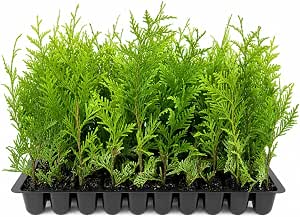 | Best Value — a practical quantity for a hedge project | Plant count: 10 live plants | Plant type: Evergreen shrub and hedge | Scientific name: Thuja standishii × plicata | VIEW LATEST PRICE | See Our Full Breakdown |
| Perfect Plants Thuja Green Giant Arborvitae Liners, 18-Pack |  | Best for large-scale planting — the most plants in this roundup | Pack size: 18 individual liners | Mature height: Up to 60 feet | Mature width: Up to 20 feet | VIEW LATEST PRICE | See Our Full Breakdown |
| privacy plants for backyard | Mature height | Mature width | USDA zones | Sun exposure |
|---|---|---|---|---|
| Thuja Green Giant | 20–40 feet | 12–20 feet | 5–9 | Full sun to partial shade |
| Perfect Plants Emerald Green A | Up to 14 feet | Up to 4 feet | 2–7 | Full sun |
| Thuja Green Giant Live Plants | — | — | — | Full sun; description also notes partial shade |
| Perfect Plants Thuja Green Gia | Up to 60 feet | Up to 20 feet | 5–9 | — |
More Details on Our Top Picks
Thuja Green Giant – (3-4ft) Live Plant, Includes Fertilizer & Planting Guide
This is my best overall pick for a buyer who wants one clearly sized plant to start a backyard screen. At 3–4 feet on arrival, it gives a more concrete starting point than the 10-plant and 18-liner sets, whose supplied descriptions do not give an equivalent individual plant height. It also comes with fertilizer and a planting guide, useful additions for someone establishing a first hedge rather than buying a bare plant without guidance.
Compared with the Emerald Green Arborvitae, this Green Giant accepts partial shade and is suited to zones 5–9, but it can become far broader and taller: its listed mature dimensions are 20–40 feet high and 12–20 feet wide. That scale can help screen an open boundary, yet it is a real commitment in a compact yard. The Emerald, with its listed 14-foot height and 4-foot width, is a more controlled fit for narrower spaces and colder zones.
The listing describes this plant as adaptable to various soils and low maintenance, with moderate watering. Those are useful traits after establishment, but they do not eliminate the need to plan for growth or provide care while a new planting takes hold. The included guide and fertilizer distinguish it from the two multi-plant Green Giant packages, though the product is still a single plant—not a finished hedge. I would choose it for a measured, gradual screen, and skip it if I needed a dense boundary immediately or could not accommodate a large mature shrub.
Pros:- Arrives as a stated 3–4-foot live plant, giving a clearer starting-size reference than the liner packs.
- Listed for full sun or partial shade in zones 5–9.
- Includes fertilizer and a planting guide.
- Large mature dimensions can suit an open boundary or tall screening plan.
Cons:- Mature size of up to 40 feet tall and 12–20 feet wide can overwhelm tight yards without pruning.
- The zones 5–9 range excludes colder regions that the Emerald Green option can serve.
- One plant does not provide the quantity needed for a continuous hedge by itself.
Best for: Backyard owners in zones 5–9 who want a single, larger Green Giant starter with a planting guide and fertilizer.
Not ideal for: Small yards, colder zones below 5, or buyers expecting one plant to create an immediate continuous hedge.
- Botanical name:Thuja ‘Green Giant’
- Delivered plant size:3–4 feet
- Mature height:20–40 feet
- Mature width:12–20 feet
- USDA zones:5–9
- Sun exposure:Full sun to partial shade
- Moisture needs:Moderate watering
- Included:Fertilizer and planting guide
Our verdict“Choose this single Green Giant when you want a substantial starter and have room for its long-term scale; pick Emerald Green for colder zones or a narrower hedge.”
Perfect Plants Emerald Green Arborvitae – 1 Gallon Privacy Hedge
I would put the Emerald Green Arborvitae at the top of the list for a backyard in a colder zone or a planting strip where width matters. Its stated hardiness range of zones 2–7 reaches colder than any Green Giant option here, and its listed mature width of 4 feet is far more contained than the Green Giant’s 12–20 feet. That narrower profile can make it easier to plan beside a fence or along a boundary where a broad hedge would take too much room.
This is a one-gallon plant, so it is a starter rather than an instant privacy wall. The description gives a mature height of up to 14 feet, but no delivery height, so I would not compare its initial size directly with the 3–4-foot Green Giant. It is described as evergreen, drought tolerant, and deer resistant, appealing traits for year-round screening and lower ongoing fuss. Still, the care notes call for regular watering, and first-year plants may need extra winter protection; the drought-tolerant label is not a reason to neglect establishment.
Compared with the single Green Giant, this option trades the Green Giant’s stated larger delivered size and partial-shade tolerance for a colder climate range and a narrower mature spread. Compared with the multi-plant packs, it is easier to trial as one plant but cannot cover a long fence alone. The listing specifies full sun and sandy soil, so buyers with shaded yards or very different soil should check whether the site suits the plant before ordering. I recommend it for a compact, cold-climate screen, not for someone who needs a broad, fast-filled boundary or lives outside zones 2–7.
Pros:- Hardy in zones 2–7, covering colder climates than the Green Giant choices.
- Listed mature width of 4 feet suits narrower planting areas.
- Evergreen foliage provides year-round screening potential.
- Described as drought tolerant and deer resistant after establishment.
Cons:- Supplied in a 1-gallon container, with no delivery height specified.
- Full-sun preference and sandy-soil specification may not suit every backyard.
- First-year plants may need extra winter protection and regular watering.
Best for: Gardeners in zones 2–7 who need an evergreen screen with a listed mature width of 4 feet.
Not ideal for: Buyers in zones 8–9, shady locations, or anyone expecting a one-gallon plant to block a view right away.
- Container size:1 gallon
- Mature height:Up to 14 feet
- Mature width:Up to 4 feet
- USDA zones:2–7
- Sun exposure:Full sun
- Soil type listed:Sandy soil
- Moisture needs:Regular watering
- Additional traits:Drought tolerant and deer resistant
Our verdict“For a colder yard or narrow hedge line, this is the best climate-and-width match, though its one-gallon size means privacy will take time to build.”
Thuja Green Giant Live Plants, 10 Count
For buyers who already know they want a row rather than a lone specimen, the 10-count Green Giant set is the most practical package in this lineup. Its stated uses include privacy hedges, windbreaks, and borders, so it is aimed squarely at a multi-plant job. It avoids the much larger commitment of 18 liners while supplying more plants than the single Green Giant. That balance earns it my best-value role based on planting scale, not on price.
The drawback is that the listing gives no individual plant height or mature dimensions, which makes planning less precise than with the single 3–4-foot Green Giant. I would measure the boundary and confirm recommended spacing with the seller or a local planting resource before treating ten plants as enough for a particular run. The plants are described as suitable for full sun to partial shade and varied soil types, but the specs list full sun; if your site is mostly shaded, verify that discrepancy before purchase.
Early care is another meaningful difference. The supplied description recommends consistent, frequent watering during the first month, so this set suits someone able to monitor a new hedge. Compared with the 18-pack, ten plants are a less extensive order, but they share the same Green Giant climate limitation: the 18-pack is explicitly listed for zones 5–9, and buyers should verify the 10-count set’s local suitability before planting. Compared with Emerald Green, this package is a better fit for a larger screen project, while Emerald makes more sense for a narrow or colder site. I would skip this if you need exact plant dimensions up front or cannot keep up with initial watering.
Pros:- Ten plants are more suited to a hedge project than the single-plant listings.
- Designed for privacy screens, windbreaks, and borders.
- Description allows for full sun to partial shade and varied soil types.
- Evergreen foliage provides year-round screening potential.
Cons:- The listing does not state individual plant height or mature dimensions.
- Frequent watering is recommended during the first month.
- Exact spacing and climate range are not supplied in the provided specifications.
Best for: Buyers planning a multi-plant hedge, border, or windbreak who can provide frequent water during the first month.
Not ideal for: Gardeners who need stated plant dimensions, have a small planting strip, or cannot manage establishment watering.
- Plant count:10 live plants
- Plant type:Evergreen shrub and hedge
- Scientific name:Thuja standishii × plicata
- Sun exposure:Full sun; description also notes partial shade
- Moisture needs:Regular watering
- Soil adaptability:Varied soil types, per description
- Recommended establishment care:Frequent watering during the first month
- Stated uses:Privacy hedge, windbreak, and border
Our verdict“Pick the 10-count set for a planned hedge with manageable scale, but confirm plant size, spacing, and local climate fit before ordering.”
Perfect Plants Thuja Green Giant Arborvitae Liners, 18-Pack
The 18-pack of Green Giant liners is the pick for someone planning a substantial screen or windbreak and prepared to establish many young plants. Its quantity is the largest in this comparison, and the wide-bottomed pyramidal growth habit is suited to a planted row. Once established, the listing describes the plants as low maintenance, with pruning available to control their shape. For a long boundary, that quantity makes more sense than buying one Green Giant and attempting to extend the hedge much later.
However, the word liners matters: this is not the same buying proposition as the 3–4-foot single plant. The listing does not provide liner height, so buyers should expect to plan around starter plants rather than assume they arrive at screening size. Its stated mature dimensions—up to 60 feet tall and 20 feet wide—also call for careful site planning. Pruning can help manage form, but a plant with this potential scale is not a low-profile choice for a narrow yard.
Compared with the 10-count set, the 18-pack supplies more plants for a larger project, while the 10-count option may be easier to manage for a smaller boundary. Both are Green Giants, but only this listing provides an explicit zones 5–9 range and a shipping restriction: it cannot ship to California or Arizona. Buyers in those states should choose another option, and those outside zones 5–9 should verify local suitability. I would select this only when the planting area, regional fit, and watering capacity match a large group of liners; otherwise, the single Green Giant offers a clearer initial size, and the Emerald is a better narrow-space choice.
Pros:- Eighteen liners support a larger planned hedge or windbreak.
- Dense, dark green evergreen foliage and a pyramidal growth habit.
- Listed for zones 5–9.
- Can be pruned to manage shape and is described as low maintenance once established.
Cons:- Liner height is not specified, so immediate screening expectations are unclear.
- Potential mature size of up to 60 feet tall and 20 feet wide requires substantial space or ongoing pruning.
- Cannot ship to California or Arizona.
Best for: Owners of a large zone 5–9 boundary who can plant and care for a group of 18 young liners.
Not ideal for: Residents of California or Arizona, small-yard gardeners, and buyers seeking mature plants or a stated liner height.
- Pack size:18 individual liners
- Mature height:Up to 60 feet
- Mature width:Up to 20 feet
- USDA zones:5–9
- Growth habit:Wide-bottomed pyramidal
- Foliage:Dense, dark green evergreen
- Maintenance:Low once established; can be pruned
- Shipping restrictions:Cannot ship to California or Arizona
Our verdict“This is the strongest quantity choice for a large, suitable site, but its liner format, mature scale, and shipping limits rule it out for many smaller backyard projects.”

How We Picked
I compared these four products as backyard privacy solutions, not simply as evergreen shrubs. That changes the ranking: a plant that can grow tall may be a poor fit for a small yard, while a larger multipack only helps if the buyer has enough boundary length and time to establish it. I weighed the stated plant size or pack quantity, mature dimensions where provided, hardiness range, light conditions, and the care information supplied with each listing.
Climate fit came first. Emerald Green Arborvitae is listed for USDA zones 2–7, while the Green Giant options are listed for zones 5–9. That makes the Emerald a more flexible choice for cold-winter yards, but it does not cover the warmest zones represented by the Green Giants. I also favored products with enough size information to help a buyer think about future space, while treating unlisted dimensions as unknown rather than filling gaps with assumptions.
I then compared how each option serves a different planting scale. The 3–4-foot single plant has a clearer delivered size than the sets, the 10-count package is aimed at a hedge or windbreak, and the 18-pack supplies the most plants but identifies them as liners. The 1-gallon Emerald is a one-plant option with a stated mature height and width. Those formats are not interchangeable: plant count, starter size, and mature spread affect both planning and the work involved.
Finally, I considered establishment and maintenance tradeoffs. The listings call for regular or moderate watering, and the 10-count listing specifically advises frequent watering through the first month. Green Giants can reach substantial dimensions, while the Emerald is narrower by its stated mature width. I did not rank by unsupported growth timelines, exact spacing, or guaranteed screening speed. My order reflects the clarity of the fit for common backyard needs, with separate picks for a single starter, colder climates, and larger planting projects.
| privacy plants for backyard | Sun exposure | Moisture needs |
|---|---|---|
| Thuja Green Giant | Full sun to partial shade | Moderate watering |
| Perfect Plants Emerald Green A | Full sun | Regular watering |
| Thuja Green Giant Live Plants | Full sun; description also notes partial shade | Regular watering |
| Perfect Plants Thuja Green Gia | — | — |
Factors to Consider When Choosing Best Privacy Plants For Backyard
I would choose a privacy plant by matching the site and planting plan before comparing pack size. The same evergreen can be a strong screen on an open boundary and a poor fit beside a narrow patio.Start with your USDA hardiness zone
Check your garden’s USDA zone before choosing between these plants. The Emerald Green Arborvitae is listed for zones 2–7, making it the option to examine first in colder regions. The Green Giant listings are for warmer ranges; the 3–4-foot plant is specified for zones 5–9, and the 18-pack is also listed for zones 5–9. The supplied specifications for the 10-count set do not state a zone range, so I would verify its fit with the seller rather than assume it matches every other Green Giant product.
Zone range is a starting point, not a guarantee that a plant will thrive in every microclimate. Exposure to wind, drainage, winter conditions, and local heat can affect results. If your yard sits near the edge of a listed range, check with a local nursery or extension resource. Buyers in California or Arizona should also note the 18-pack’s explicit shipping restriction.
Match mature width and height to the yard
Privacy planting needs room not only along the fence, but also around the mature plants. Emerald Green has the most compact stated dimensions here: up to 14 feet tall and 4 feet wide. The single Green Giant is listed at 20–40 feet tall and 12–20 feet wide; the 18-pack listing gives potential dimensions of up to 60 feet tall and 20 feet wide. Those Green Giant sizes may suit a spacious property, but can crowd a small yard or nearby structures if left unchecked.
Do not treat pruning as a substitute for choosing the right plant. Trimming can shape a hedge, but it takes repeated work and cannot make a large-growing evergreen behave like a naturally compact one. The 10-count product does not provide mature dimensions in the supplied specs, so confirm the expected size before using it along a tight boundary. I would also look up spacing guidance for the specific plant size and site rather than guessing from the package count.
Choose a quantity that matches the project
The single 3–4-foot Green Giant is a straightforward way to begin with a stated plant size, but one plant will not form a continuous hedge. The 10-count set is aimed at a multi-plant screen or windbreak, while the 18-pack is better suited to a larger planting plan. The Emerald is also sold as a single one-gallon plant, so its narrower form may be more useful for a small section or for adding to an existing line than covering a long boundary by itself.
Plant count does not tell you how much fence a pack will cover. The listings do not provide a consistent spacing recommendation, and the starting dimensions of the 10-count set and 18 liners are not stated. Before buying, measure the length you want to screen, check recommended spacing for the delivered plant size, and decide whether you want a dense hedge or a looser row. For a long boundary, it may be better to compare the planting plan with a local nursery than to assume a pack quantity equals a fixed screen length.
Plan for watering and establishment
Even plants described as low maintenance need attention while their roots establish. The 10-count Green Giant listing specifically recommends frequent, consistent watering during the first month. Emerald Green is labeled drought tolerant, but its listed moisture needs are regular watering, and first-year plants may need winter protection. The single Green Giant calls for moderate watering. These notes point to a common practical requirement: be ready to monitor newly planted trees, particularly through dry weather.
If you are planting a large pack, think about whether you can water every plant evenly and keep up with care after planting. A larger quantity can make a screen project more efficient, but it also multiplies the work at establishment. Prepare the site and planting holes first, then place plants in a season and weather window that allows you to provide follow-up care. Follow the product’s included guide where available, and seek local advice for soil preparation or watering schedules specific to your conditions.
Think about sun, soil, and maintenance honestly
The Emerald listing specifies full sun and sandy soil. The single Green Giant is listed for full sun to partial shade and is described as adaptable to various soils. The 10-count description also mentions full sun to partial shade and varied soil, although its specification lists full sun. That difference is a reason to confirm site suitability if your yard has substantial shade. The 18-pack details emphasize zone range and mature size but do not give the same level of sun and soil information.
For the least uncertainty, compare the actual planting site with the product details, then check any gaps before placing an order. Also be realistic about pruning: the Green Giants may become very large, and the 18-pack explicitly says they can be pruned to size. Emerald’s narrower listed width can reduce the need to manage lateral spread, but it is still a living hedge that needs care. Pick based on the maintenance you are willing to provide, not on the phrase low maintenance alone.
Frequently Asked Questions
Which plant in this roundup is best for a colder backyard?
The Emerald Green Arborvitae has the broadest cold-climate range listed here, USDA zones 2–7. The single Green Giant is listed for zones 5–9, and the 18-pack is listed for zones 5–9. The 10-count listing does not provide a zone range in the supplied details, so I would verify it before ordering for a colder region. Check your local growing conditions as well as the zone label, especially if the planting site is exposed to winter wind.
Which option is the best choice for a narrow backyard?
The Emerald Green is the clearest fit for a narrower planting strip because its listed mature width is up to 4 feet. The Green Giant listings describe much larger potential dimensions, including mature widths of 12–20 feet for the single plant and up to 20 feet for the 18-pack. Those figures call for more room or a commitment to pruning. I would still check site conditions and spacing guidance before planting even the narrower option.
Will any of these plants provide instant privacy?
None of the listings promises an instant, continuous privacy wall. The single Green Giant arrives at a stated 3–4 feet, while Emerald Green is listed in a one-gallon container and the other packages are sets of plants or liners without a supplied individual height. Evergreen foliage can support year-round screening as plants grow, but the time needed to block a particular view depends on delivered size, spacing, establishment, and growing conditions. For immediate coverage, compare delivered dimensions with the height of the view you need to screen.
How many plants do I need for a backyard hedge?
The product listings do not give a consistent spacing recommendation, so I would not use pack count alone to estimate fence coverage. Measure the planting run, then confirm spacing for the specific plant size and the dense or open look you want. The 10-count set is aimed at a hedge or windbreak, and the 18-pack supplies more liners for a larger project, but neither listing gives a guaranteed coverage length. Ask the seller or a local nursery for spacing guidance before purchasing.
Do Green Giant arborvitae need pruning?
Pruning may be useful if you need to manage the size or shape of a Green Giant, particularly because the listings give substantial potential mature dimensions. The 18-pack description specifically says the plants can be pruned to size. That does not remove the need to allow room for growth or plan ongoing maintenance. If you want a naturally narrower option, Emerald Green has a listed mature width of 4 feet, compared with the much broader figures given for Green Giant.
Conclusion
My recommendation depends on the yard and the work you want to take on. Choose the 3–4-foot single Green Giant if you garden in zones 5–9, want a clearly sized starter, and have room for a large mature plant. Pick the Emerald Green Arborvitae for a colder climate or a narrower screen, while accepting that its one-gallon format will need time to grow in.
If you are planting a hedge or windbreak, the 10-count Green Giant set is the more moderate multi-plant option, provided you can water it frequently at first and confirm its dimensions and climate fit. The 18-pack of liners makes sense for a larger zone 5–9 planting with room for substantial growth; skip it if you live in California or Arizona, have a small yard, or want screening plants that arrive at a stated larger size. Across all four, I would let climate range, mature width, and establishment capacity guide the decision before choosing by quantity.