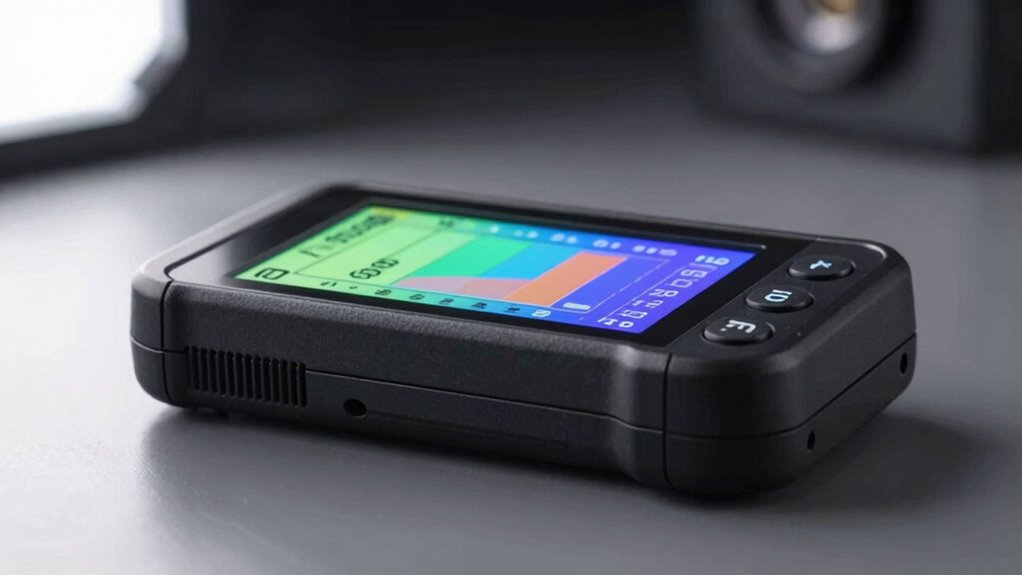

PAR meters may look technical, but their main goal is simple: they help you guarantee your aquatic plants and corals get the right amount of light. By measuring light levels accurately, they prevent under or over-lighting, promoting healthy growth. While they might seem complex at first, calibration and easy-to-use features make them accessible. Keep exploring, and you’ll discover how these tools keep your tank thriving with just the right lighting.
Key Takeaways
- PAR meters measure light levels to ensure aquatic plants and corals receive optimal lighting for healthy growth.
- Their technical appearance hides a straightforward purpose: accurately assessing light intensity in aquatic environments.
- Proper calibration makes these devices reliable, simplifying the process of maintaining ideal lighting conditions.
- Advances in design have made PAR meters more user-friendly despite their technical features.
- Ultimately, they solve the simple problem of providing the right amount of light for aquatic ecosystem health.
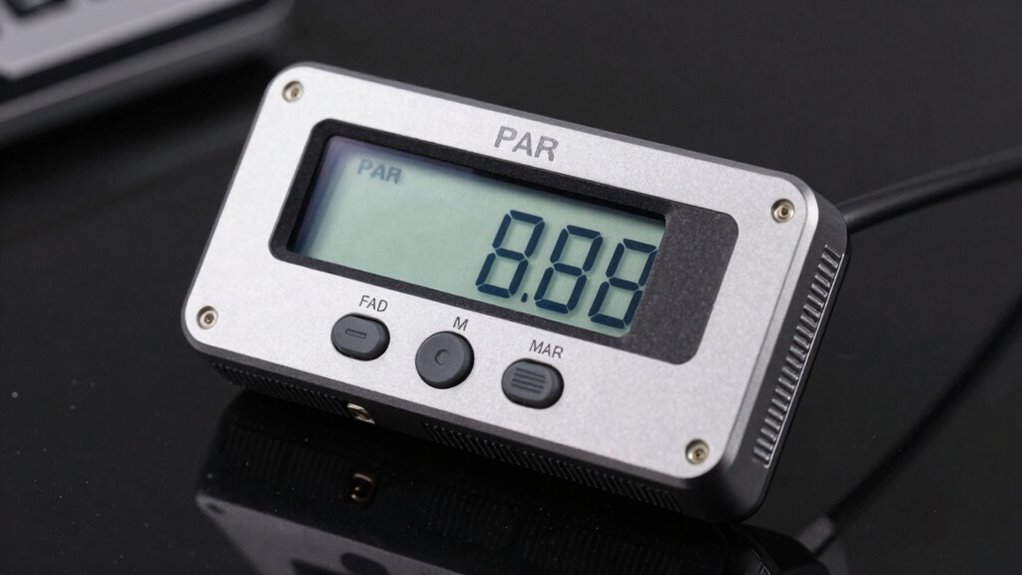
PAR meters may look complex and technical at first glance, but they actually address a straightforward problem: measuring the amount of light available for aquatic plants and corals. Understanding how much light penetrates your tank is vital for maintaining a healthy aquatic environment. This is where PAR meters come in, providing precise readings that help you enhance lighting conditions. Although these devices may seem intimidating initially, their core purpose is simple: guaranteeing your plants and corals receive the right amount of light to thrive.
PAR meters measure light levels to ensure aquatic plants and corals receive optimal lighting for healthy growth.
To appreciate the usefulness of PAR meters, it helps to know a bit about their calibration processes. Calibration ensures that a PAR meter gives accurate readings, which is essential because light intensity can vary depending on the device and environment. During calibration, you compare the meter’s readings to a known standard, often a light source with a fixed and verified output. This process might involve adjusting the meter or using calibration cards designed specifically for PAR measurement. Regular calibration keeps your readings reliable, giving you confidence that your aquatic life is getting the appropriate light levels. Many modern PAR meters feature user-friendly calibration procedures, making it easier for hobbyists and professionals alike to maintain accuracy without needing specialized technical knowledge. Understanding sensor calibration is key to ensuring your device provides trustworthy data.
The historical development of PAR meters reveals how they evolved from simple light sensors to sophisticated instruments tailored for the needs of aquarists. Originally, light measurement tools were designed for photography and general scientific use, not for aquatic environments. Over time, as the importance of proper lighting in reef tanks and aquatic plant setups became clear, specialized PAR meters were developed. Advances in sensor technology and electronics made these devices more compact, affordable, and accurate. Today’s PAR meters often incorporate digital displays, data logging, and user-friendly interfaces, reflecting decades of technological progress. This evolution means you now have access to precise and reliable tools that were once only available to scientists or large laboratories. Additionally, understanding light measurement techniques can help hobbyists optimize their tank conditions more effectively.
Despite their technical sophistication, PAR meters are fundamentally about simplicity: ensuring your aquatic environment gets the right amount of light. Their calibration processes and development history underscore their role as essential tools rather than complicated gadgets. As you learn to use a PAR meter, you’ll come to see it as an invaluable asset in maintaining a thriving aquatic ecosystem. The more you understand its calibration and development, the better you’ll be at fine-tuning your tank’s lighting—helping your plants and corals flourish under ideal conditions.

VBR-Aqua IP68 PAR Meter for Aquarium,Reef.R,G,B PAR Seperately.with a 3FT Telescopic Rod
PAR Meter for Aquarium specially. IP68 Waterproof Sensor with a 3F telescopic rod.
As an affiliate, we earn on qualifying purchases.
As an affiliate, we earn on qualifying purchases.
Frequently Asked Questions
How Do PAR Meters Measure Light Intensity?
You point the PAR meter at your light source, and it measures light intensity by detecting the light spectrum that plants use for photosynthesis. The device uses sensors to capture the amount of light within the specific spectrum, ensuring accuracy. This way, you get a reliable reading of how much usable light your plants receive, making it easier to adjust your lighting setup for ideal growth.
Are PAR Meters Suitable for All Types of Grow Lights?
Is a chameleon suitable for every environment? Not quite, and the same goes for PAR meters. They’re best for measuring light across different grow light spectrums, but their photometric accuracy varies with certain light types. While versatile, some specialized grow lights might require calibration or alternative tools for precise readings. So, before relying solely on a PAR meter, check its compatibility with your specific grow light spectrum for ideal results.
How Often Should I Calibrate My PAR Meter?
You should calibrate your PAR meter at least once every six months to guarantee accurate readings of plant growth and light spectrum. Regular calibration helps you maintain ideal light conditions, which directly affect your plants’ development. If you notice inconsistent readings or changes in plant health, calibrate more frequently. This way, you can fine-tune your lighting setup, ensuring your plants receive the right amount of light for healthy growth.
Can PAR Meters Be Used for Outdoor Lighting Assessments?
Yes, you can use PAR meters for outdoor lighting assessments, especially if you’re working on garden design or outdoor spaces. They help you measure light intensity accurately, ensuring your plants—whether in outdoor gardens or indoor gardening setups—get the right amount of light. Using a PAR meter outdoors allows you to optimize sunlight and artificial lighting, promoting healthy growth and vibrant results in all your gardening projects.
What Is the Ideal PAR Level for Different Plants?
The ideal PAR level varies depending on the plant’s needs, but generally, you should aim for 200-400 µmol/m²/sec for most foliage plants. To determine what’s best, focus on plant nutrition and conduct soil testing to adjust light levels accordingly. Healthy plants thrive when their PAR exposure matches their specific requirements, so regularly monitor and modify your lighting to support best growth.

AH-Reef PAR Meter,Test PPFD,UVA w/m²,Waterproof Sensor,Show R,G,B% in Aquarium Light.Record PAR | UVA Distribution
All-in-One Spectrum Measurement: Accurately measures full-spectrum PAR (400–700nm) and UVA plus individual red, green, and blue (RGB) PPFD…
As an affiliate, we earn on qualifying purchases.
As an affiliate, we earn on qualifying purchases.
Conclusion
So, don’t be fooled by their technical appearance—par meters are like the quiet heroes of the electrical world. They may look complex, but they simply make sure your appliances get the right amount of power. Think of them as the gatekeepers, quietly ensuring everything runs smoothly behind the scenes. Next time you see one, remember, sometimes the simplest tools are the most powerful, quietly holding chaos at bay like a lighthouse guiding ships safely home.
VBR-Aqua IP68 PAR Meter for Aquarium,Reef.R,G,B PAR Seperately.with a 3FT Telescopic Rod
PAR Meter for Aquarium specially. IP68 Waterproof Sensor with a 3F telescopic rod.
As an affiliate, we earn on qualifying purchases.
As an affiliate, we earn on qualifying purchases.

AH-Quantuv PAR Meter for Grow Lights, PPFD Meter 400-750nm with UVA Measurement 320-400nm, Shows PAR Breakdown of Blue Green Red, Records PAR & UVA for Light Distribution Mapping
Measure PAR and UVA Light Accurately. Measure PAR (400–750nm) and UVA (320–400nm) irradiance intensity to understand how your…
As an affiliate, we earn on qualifying purchases.
As an affiliate, we earn on qualifying purchases.