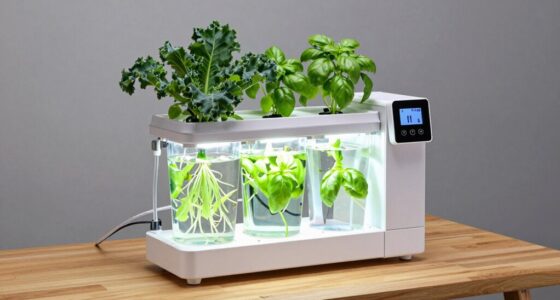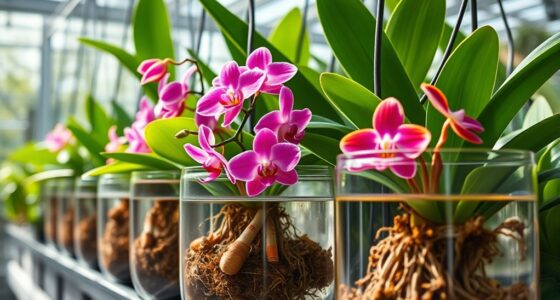
In small hydroponic kits, you control nutrients, lighting, and adjustments manually, making quick tweaks easy. For larger systems, you’ll need systematic nutrient schedules, automated dosing, and multiple light fixtures to guarantee even coverage. Monitoring and maintenance become more complex, requiring detailed record-keeping and technical skills. As the scale increases, your workflow shifts from hands-on to highly coordinated efforts. Stick around to discover how mastering these differences boosts your system’s efficiency and crop health.

Get garden gear delivered free with Prime
- Fast, free delivery on millions of items
- Prime Video, Amazon Music and more included
- Member-only deals all year
Key Takeaways
- Small kits allow direct, manual adjustments, while large systems depend on automated, scheduled nutrient and lighting management.
- Monitoring and maintaining environmental conditions are simpler in small setups but require detailed tracking in larger systems.
- Large hydroponic kits involve complex automation and system checks, whereas small kits rely on basic manual controls.
- Workflow complexity increases with scale, requiring meticulous planning, record-keeping, and component integration in large systems.
- Nutrient and light adjustments are straightforward in small kits but require systematic scheduling and calibration in large setups.

Whether you’re just starting with hydroponics or expanding an existing setup, understanding the workflow differences between small and large hydroponic kits is essential. As you scale up, the complexity of managing nutrients and lighting becomes markedly more demanding. In smaller systems, you typically handle nutrient management with straightforward adjustments—adding nutrient solutions directly to the reservoir and monitoring pH levels periodically. But as your operation grows, this process demands a more systematic approach. You need to develop detailed schedules for nutrient concentrations, monitor runoff, and prevent imbalances that could lead to deficiencies or toxicities. You might also need automated dosing systems or multiple reservoirs to ensure consistent nutrient delivery across larger plant populations.
Scaling up hydroponics requires systematic nutrient management and precise control to ensure healthy, balanced plant growth.
Lighting optimization, which is relatively simple in small setups, takes on new importance and complexity in larger systems. In a small hydroponic kit, you can often rely on a single light source, adjusting its distance or intensity manually based on plant growth stages. When you scale up, uniform lighting becomes a challenge. You must plan for multiple light fixtures, ensuring even coverage and minimizing shadows that could inhibit photosynthesis. With larger setups, you often use grow lights with programmable timers, dimming features, or spectrum controls that need regular calibration. Managing lighting schedules also becomes more intricate, as different plant varieties or growth stages may require tailored light cycles to optimize growth and flowering.
The workflow for larger hydroponic kits also involves more extensive planning and record-keeping. You’ll need to track nutrient formulations, monitor environmental conditions like temperature and humidity, and adjust lighting schedules accordingly. Automation plays a bigger role here, reducing manual labor but requiring technical knowledge to set up and maintain. Regular system checks for pumps, filters, and reservoirs are critical to prevent failures that could jeopardize entire crops. Additionally, understanding system scalability is vital to ensure your setup can grow without major disruptions.
In essence, the core difference lies in the complexity and scale of nutrient management and lighting optimization. Small systems offer simplicity and hands-on control, while large systems demand a systematic, often automated approach that integrates multiple components seamlessly. As you expand, your workflow shifts from basic adjustments to detailed planning, monitoring, and fine-tuning. Mastering these differences ensures your hydroponic operation remains efficient, productive, and healthy, regardless of size.
Products Worth Considering

EGO POWER+ 20-Inch Cordless Chainsaw with 56V 6.0Ah Battery and Charger (CS2005)

Orbit B-hyve XR 8-Zone Indoor/Outdoor Smart Sprinkler Controller

Traeger Woodridge Wood Pellet Grill and Smoker, 860 sq. in., WiFIRE
As an affiliate, we earn on qualifying purchases.
Frequently Asked Questions
How Do Maintenance Routines Differ Between Small and Large Hydroponic Systems?
In small hydroponic systems, you perform maintenance routines more frequently, focusing on quick nutrient management and pH adjustments to keep plants healthy. For large systems, you schedule less often but conduct more thorough checks, including nutrient levels and pH balance, to guarantee the entire setup functions smoothly. Both require consistent monitoring, but the scale influences how often and how deeply you perform these maintenance routines.
What Are the Initial Setup Costs for Small Versus Large Kits?
You’ll find that initial setup costs for small hydroponic kits are typically under $200, while large systems can start around $1,000 or more. A key factor is the cost comparison, which heavily depends on space requirements; small kits need less room and fewer components, making them more affordable upfront. Large setups demand higher investments but can produce more yield, making them suitable for serious growers.
How Does Plant Selection Vary With Kit Size?
With small kits, you usually choose fewer plant varieties, focusing on high-growth, space-efficient options like herbs or lettuce. Larger kits allow for greater plant diversity, letting you experiment with different vegetables and flowering plants. Growth rates vary depending on plant selection, but larger kits support more diverse species, which may grow at different speeds. Your choice influences how quickly you see results and how much maintenance each plant requires.
Are There Differences in Troubleshooting Common System Issues?
Troubleshooting system issues is like untangling a knot—you need patience and focus. In larger kits, you might face more complex problems, requiring careful nutrient optimization and pH balancing to keep plants healthy. Small kits often have straightforward fixes, but larger systems demand a methodical approach, checking pumps, filters, and sensors. Understanding these nuances helps you swiftly diagnose and resolve issues, ensuring your hydroponic setup runs smoothly.
How Do Energy Consumption Levels Compare Across Kit Sizes?
Energy consumption levels vary considerably between small and large hydroponic kits. Larger systems typically have higher power consumption due to more extensive pumps, lights, and equipment, but they often offer better energy efficiency per unit of produce. Smaller kits use less power overall, making them more energy-efficient for limited spaces or beginners. To optimize energy efficiency, monitor power consumption closely and choose equipment that balances performance with low power use.
Conclusion
Just like tending a tiny bonsai requires delicate care, small hydroponic kits demand your close attention and hands-on approach. Meanwhile, large systems are like managing a lush garden—more complex but offering efficiency once set up. Whether you’re nurturing a single plant or an entire indoor farm, understanding these workflow differences helps you grow successfully. Think of it as mastering the art of gardening—start small, learn quickly, then expand your green thumb with confidence.