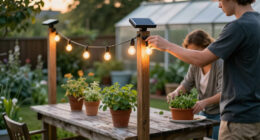
Install solar-powered garden string lights by choosing a sunny panel location, mounting the lights securely, and testing them after the battery charges. This guide is for beginners setting up lights in a garden, on a patio, or along a fence. Plan for about 1–2 hours of installation, then allow a full day of direct sunlight for the first charge before judging the nighttime result.

Get garden gear delivered free with Prime
- Fast, free delivery on millions of items
- Prime Video, Amazon Music and more included
- Member-only deals all year
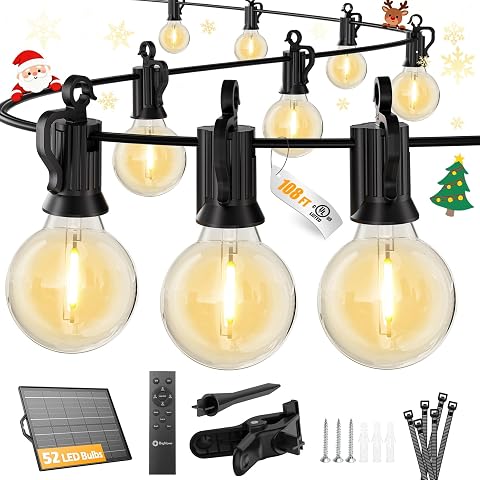
Brightown 108FT 52LED Solar String Lights Outdoor with Remote & USB Port
- ✔ Length: 108 feet
- ✔ Bulbs: 50 LED G40 bulbs plus 2 spare bulbs
- ✔ Light color: Warm white, 2700K

Amzrap 200FT Solar String Lights Outdoor Waterproof 72+2 LED Bulbs, Solar Powered with Remote & USB Port, 3 Light Modes Dimmable…
- ✔ Length: 200 feet
- ✔ Bulbs: 72 LED bulbs plus 2 spare bulbs
- ✔ Light color: Warm white, 2700K

Joomer Solar Fairy Lights, 2-Pack Total 80FT 240LED Lights, Warm White
- ✔ Total listed length: 80 feet across two strands
- ✔ Strand length: About 39 feet each
- ✔ LEDs: 240 total
Difficulty: Beginner | Time: 1–2 hours, plus a full day for the first charge
What You’ll Need
Tools & Materials:
- Solar string light set with panel, battery, and mounting hardware
- Tape measure
- Soft cloth
- Outdoor-rated hooks, clips, or cable ties suited to the mounting surface
- Screwdriver or drill, if the mounting hardware requires one
- Ladder, if needed for a safe reach
Knowledge:
- Basic measuring and safe use of hand tools
- How to identify a spot that receives direct sunlight
Check the product instructions for the light set’s outdoor rating, maximum span, charging method, and mounting requirements. Choose hardware suitable for the surface and weather. Do not install lights near overhead power lines, and do not climb a ladder on uneven or soft ground.
Brightown 108FT 52LED Solar String Lights Outdoor with Remote & USB Port
Brightown earns the top spot because it combines the familiar look of G40 patio bulbs with controls that make the lights adaptable after they are hung. The remote adjusts brightness across four levels, selects steady, breathing, or flashing modes, and offers six- or eight-hour timers. That is more useful for a regular dining or lounging area than Joomer’s decorative modes alone: we can set a softer glow for a quiet evening without reshaping or rewiring the display.At 108 feet with 50 bulbs plus two spares, it has meaningful reach while remaining more manageable than Amzrap’s 200-foot run. Brightown also provides USB-C charging alongside solar, a practical fallback for cloudy stretches or indoor use. The 180-degree adjustable panel gives some placement flexibility, and the included clip and cable ties help with installation. Its listed runtime and battery-life statements are product claims, so actual illumination will depend on charging conditions and settings.There are limits to the flexibility. Brightown says the string cannot be connected, so buyers should map the route before mounting and not expect to extend it with another set. It is also a heavier, bulb-based installation than Joomer’s thin copper wire, and the solar panel still needs a useful sun-facing location. For most buyers seeking one controllable string around a patio, however, the mix of scale, dimming, timers, and backup charging is the strongest all-around fit.
Pros:
- 108-foot patio string with 50 G40 bulbs and two spare bulbs
- Remote offers four brightness levels, three modes, and two timer settings
- Solar and USB-C charging provide a fallback when sunlight is limited
- Includes cable ties and an adjustable panel mounting clip
Cons:
- String cannot be connected to another set for added length
- Bulb-style lights and a 3.3-pound listed weight make it less delicate than fairy wire
- Solar operation still depends on placing the panel where it can receive sunlight
Best for: Garden and patio owners who want warm ambient bulb lighting, remote dimming, and USB charging in a medium-to-large outdoor area.
Not ideal for: Buyers who need connectable strings, a very compact decorative strand, or a setup where the solar panel cannot reach sunlight and USB access is inconvenient.
Bottom line: For a typical patio where we want adjustable ambiance and backup charging, Brightown offers the most complete balance of coverage and control.
“For a typical patio where we want adjustable ambiance and backup charging, Brightown offers the most complete balance of coverage and control.”
Amzrap 200FT Solar String Lights Outdoor Waterproof 72+2 LED Bulbs, Solar Powered with Remote & USB Port, 3 Light Modes Dimmable…
When the main challenge is getting light across a broad yard, Amzrap’s 200-foot single string is the standout. It is substantially longer than Brightown’s 108 feet and can cover an expansive pergola, fence line, or commercial patio without relying on several shorter runs. The set includes 72 bulbs plus two spares, and its shatterproof plastic construction is aimed at outdoor settings where fragile bulbs would be a concern.Amzrap retains the practical controls that make Brightown appealing: a remote, dimming, three modes, and a timer, here with 2-, 4-, 6-, or 8-hour settings. It also offers USB charging for stretches when the solar panel cannot collect enough sun. Compared with Joomer’s thin, bendable fairy lights, this is clearly a structural patio-light format meant to define a large space with regular bulbs, not to wrap tightly around small branches or detailed arrangements.The added reach is also the main tradeoff. A 200-foot line can be awkward to route, secure, and store in a modest garden, and the product description does not provide the same clear bulb spacing detail Brightown supplies. We would plan anchor points and panel exposure before installation. The available listing describes an oversized panel and a four-hour USB recharge, but does not specify panel wattage or a guaranteed runtime, so buyers should avoid assuming the length alone ensures all-night brightness.
Pros:
- 200-foot run offers the greatest coverage in this comparison
- 72 LED bulbs plus two spares use shatterproof plastic
- Remote includes dimming, three modes, and four timer durations
- Solar operation is supplemented by USB charging
Cons:
- The long run may be difficult to route and secure in a compact garden
- Bulb spacing and solar panel wattage are not stated in the supplied details
- Less adaptable for intricate wrapping than Joomer’s flexible fairy-light wire
Best for: Owners of large backyards, long pergolas, or expansive outdoor gathering areas who want one long bulb string with remote control and USB backup charging.
Not ideal for: Small patios, delicate tree or railing decorations, or shoppers who need detailed published information about bulb spacing and solar panel output.
Bottom line: Choose Amzrap when a large outdoor area makes reach the priority and we can plan a practical route for the long string.
“Choose Amzrap when a large outdoor area makes reach the priority and we can plan a practical route for the long string.”
Joomer Solar Fairy Lights, 2-Pack Total 80FT 240LED Lights, Warm White
Joomer takes a different approach from the patio bulb sets: its two 39-foot flexible-wire strands are designed to bend around shapes, rather than hang as a row of larger bulbs. That makes the set a better match for garden branches, fences, planters, or seasonal displays where we want points of warm light to follow an outline. The 240 LEDs across two strands provide many small light sources, while the copper wire can be arranged with a 360-degree viewing angle.Against Brightown and Amzrap, Joomer is easier to adapt to intricate shapes and less imposing in a small garden. It also arrives as a two-pack, so we can decorate separate spots instead of routing one long patio line. The tradeoff is that it does not offer the same bulb-style ambient lighting or the listed remote dimming and timer controls of either larger set. Its eight lighting modes are aimed at decorative effects, which may be more than needed if we simply want steady illumination for dinner.The supplied details describe solar charging and automatic dusk operation, but do not list USB backup, panel adjustability, IP rating, or a stated runtime. That leaves less guidance for gardens with partial shade or changing weather than Brightown provides. Joomer is the most appropriate pick when shapeability and small-scale decoration matter more than dependable broad coverage; buyers should skip it if they expect it to light a seating area like a patio bulb string.
Pros:
- Two separate 39-foot strands suit decorating distinct areas
- Flexible copper wire can be shaped around garden features
- 240 warm-white LEDs provide dense decorative points of light
- Eight lighting modes and automatic dusk operation are listed
Cons:
- No USB charging fallback is described in the supplied product details
- No stated IP rating or runtime is provided
- Less suited to broad, even patio lighting than the bulb-style sets
Best for: Buyers decorating branches, railings, planters, or small garden features who want two flexible strands of warm fairy lights.
Not ideal for: Anyone seeking broad patio illumination, remote brightness control, a timer, or documented USB backup charging and weather protection.
Bottom line: Joomer is the right fit when we want flexible decorative accents, while Brightown or Amzrap is better for lighting a larger seating space.
“Joomer is the right fit when we want flexible decorative accents, while Brightown or Amzrap is better for lighting a larger seating space.”
As an Amazon Associate we earn from qualifying purchases.
Before You Start
Unpack the set and check that the panel, light strand, stake or bracket, battery, and fasteners are present and undamaged. Some models ship with a pull tab over the battery or an OFF switch; remove the tab or set the switch as directed before charging. Wipe dust from the panel with a soft, dry cloth. Pick a clear route for the cable so people will not trip over it and garden tools will not snag it.
Solar lights depend on the panel’s exposure, not just where the bulbs hang. A shaded panel can leave the battery undercharged even when the lights are in an attractive spot. Plan to place the panel in direct sun and use its extension cable, if supplied, to reach a sunnier position.
Step-by-Step Instructions
Step 1: Choose a sunny panel location
Watch the garden during the day and select a location where the panel receives several hours of direct sunlight, ideally for most of the day. Check for shade from trees, fences, buildings, and seasonal foliage. Put the panel where it can face the sun and where you can reach it for cleaning or repositioning.
Tip: A bright area under a tree canopy may still provide too little direct sun. If the set has an extension cable, place the panel in the sun while routing the lights to the desired area.
Check: The panel’s planned position is clear of regular shade and reachable for maintenance.
Step 2: Measure the lighting route
Measure the distance along the route where the bulbs will hang, then compare it with the light strand’s usable length. Mark where the first and last bulbs should sit and where each hook or clip will go. Leave enough slack for a gentle drape, while keeping the strand within the manufacturer’s span and support guidance.
Tip: Do not pull the strand tight to make it reach. Tension can damage wires or pull fasteners loose in wind.
Check: The planned route fits the strand, with support points and a little slack marked.
Step 3: Prepare the mounting points
Install outdoor-rated hooks or clips along the marked route, using hardware made for wood, masonry, or the chosen surface. Space supports according to the product instructions and add support near corners or changes in direction. If using a ladder, set it on firm, level ground and keep your body centered between its rails.
Tip: Avoid stapling through the cable or placing a fastener where it can crush a wire. Use the light set’s clips when provided.
Check: Each support is firmly attached, and no mounting point pinches or cuts the cable.
Step 4: Mount the solar panel
Attach the panel to its bracket or stake as instructed. For a ground stake, press it into firm soil without striking the panel or cable. For a wall or fence mount, use suitable fasteners and check that the panel sits securely. Angle the panel toward the open sky and sun rather than toward the shaded lighting area.
Tip: Do not force a stake into rocky or very hard ground. Loosen the soil first or use the supplied wall mount if the instructions allow it.
Check: The panel is stable, angled toward sunlight, and its cable can reach the lights without stretching.
Step 5: Hang the light strand
Starting at the panel or the end specified in the instructions, place the strand into each clip or hook. Keep the cable supported and make a relaxed curve between points. Route any connecting cable along a wall, fence, or other protected edge, and secure loose sections so they cannot catch on feet, pets, or equipment.
Tip: Keep connectors and the battery compartment oriented as directed so rain drains away from openings. Do not bury connectors in soil or place them in standing water.
Check: The bulbs hang at the intended height, the cable has no sharp bends, and the route is clear of walkways.
Step 6: Set the operating mode and charge
Turn the lights on or select the desired mode using the switch or control described in the manual. Some panels need the switch set to ON while charging, and some include a separate test button. Leave the panel in direct sunlight for the recommended initial charge period; if the manual gives no period, allow a full sunny day before evaluating the lights.
Tip: The panel may not turn the lights on in daylight because its sensor detects ambient light. Use the manual’s test method instead of assuming the set is faulty.
Check: The switch is in the correct operating position, the panel has had the recommended charging time, and the manual’s daytime test behaves as described.
Step 7: Test the lights after dark
After sunset, check whether the lights turn on automatically or use the control to test them. Confirm that the bulbs illuminate along the strand and that the selected mode works. If they do not light, move the panel switch to the instructed position, cover the panel briefly if the manual permits a sensor test, and inspect the connectors.
Tip: Give the set a full charge before comparing brightness or run time. Cloudy weather and seasonal shade can reduce the first night’s performance.
Check: The strand lights after dark, stays connected along its length, and turns off or changes mode as specified by the product.
Common Mistakes to Avoid
- Mounting the panel where it is shaded for much of the day. — Check the sun path before installation and position the panel in the brightest practical location, using an extension cable if included.
- Pulling the strand tight between supports. — Leave a gentle drape and install enough clips to support the cable without tension.
- Expecting full brightness before the first proper charge. — Follow the product’s charging instructions and allow a full sunny day when no initial charge period is stated.
- Leaving a connector or cable where water collects or people walk. — Route cables along an edge, keep connectors positioned as directed, and secure sections that could become trip hazards.
Troubleshooting
Problem: The lights do not turn on at night.
Solution: Check that the switch is on, remove any battery pull tab, reconnect loose plugs, and confirm the panel received direct sunlight. Charge for another sunny day, then test again. Consult the manual for sensor or mode settings.
Problem: The lights are dim or turn off early.
Solution: Move the panel away from shade, clean its surface, and let the battery charge through a clear day. Cold weather, cloudy skies, and an aging battery can shorten run time; check the product guidance for battery replacement.
Problem: Only part of the strand lights.
Solution: Turn the set off before checking plugs and cable connections. Reconnect them as instructed and inspect for visible damage. Do not use a strand with frayed wires, cracked insulation, or water inside a sealed connector; contact the seller or replace the damaged set.
Problem: The lights turn on during the day.
Solution: Check whether the panel is receiving shade or whether the light sensor is covered or obstructed. Reposition the panel in open daylight and confirm the switch is set to the automatic mode described in the manual.
What Success Looks Like
The panel sits securely in a sunny location, the strand follows the planned route without tension or damage, and cables and connectors are kept clear of walkways and standing water. After an adequate charge, the bulbs illuminate after dark and operate in the selected mode. The installation also remains stable when gently checked at its supports.
Next Steps
Wipe the panel when dust or leaves collect on it, and check the clips and cable after storms or strong winds. Reposition the panel if nearby plants grow and create shade. Before winter, follow the manufacturer’s storage advice for your climate; switch the lights off or store the set indoors if the product instructions call for it. If performance drops after years of use, check whether the battery is replaceable and use only a compatible part.
Frequently Asked Questions
How much sun do solar garden string lights need?
They need direct sunlight on the panel for the charging period stated by the manufacturer. Several hours of direct sun is a practical starting point, but more exposure generally supports longer evening operation. Shade and cloudy weather reduce charging.
Can I put the panel in a sunny spot away from the lights?
Yes, if the set includes an extension cable long enough to connect the panel and strand. Keep the cable protected, within the product’s reach limits, and out of walkways.
Why do the lights not switch on while I am installing them in daylight?
The panel’s light sensor may prevent automatic operation in bright conditions. Use the manual’s test button or cover the panel briefly only if the instructions say that is a valid test.
Can solar string lights stay outside in rain?
Check the product’s outdoor or water resistance rating and its instructions. Keep connectors positioned as directed, avoid standing water, and bring the set in during conditions the manufacturer says it cannot withstand.
How do I know whether the battery needs replacing?
First clean and reposition the panel, then allow a full charge in good sunlight. If the lights still run for much less time than before, check the manual for battery replacement guidance and compatible battery specifications.