
TL;DR

Get garden gear delivered free with Prime
- Fast, free delivery on millions of items
- Prime Video, Amazon Music and more included
- Member-only deals all year
A Homes & Gardens report recommends three October preparations for Japanese maples: remove dead, diseased or broken branches, mulch around roots, and protect vulnerable trunks from winter sunscald and animal browsing. Arborist Fred Breglia advises limiting pruning to necessary cuts, keeping mulch away from the trunk and using breathable trunk protection.
Homes & Gardens has outlined three October preparations for Japanese maples, drawing on advice from Fred Breglia, an International Society of Arboriculture-certified arborist: remove damaged branches, add or refresh mulch, and protect trunks from winter sunscald and animal damage. The recommendations are intended to help gardeners prepare trees, particularly young maples, for cold-weather stress.
Breglia recommends removing dead, diseased or broken branches so problems are less likely to spread to healthy parts of a tree. The report advises using sharp bypass pruners or loppers for smaller branches and a pruning saw for larger limbs, while limiting October work to essential cuts rather than carrying out major pruning. Breglia cautions that pruning at unsuitable times can lead to sap release, and that late-summer or early-fall pruning may encourage tender growth vulnerable to winter injury.
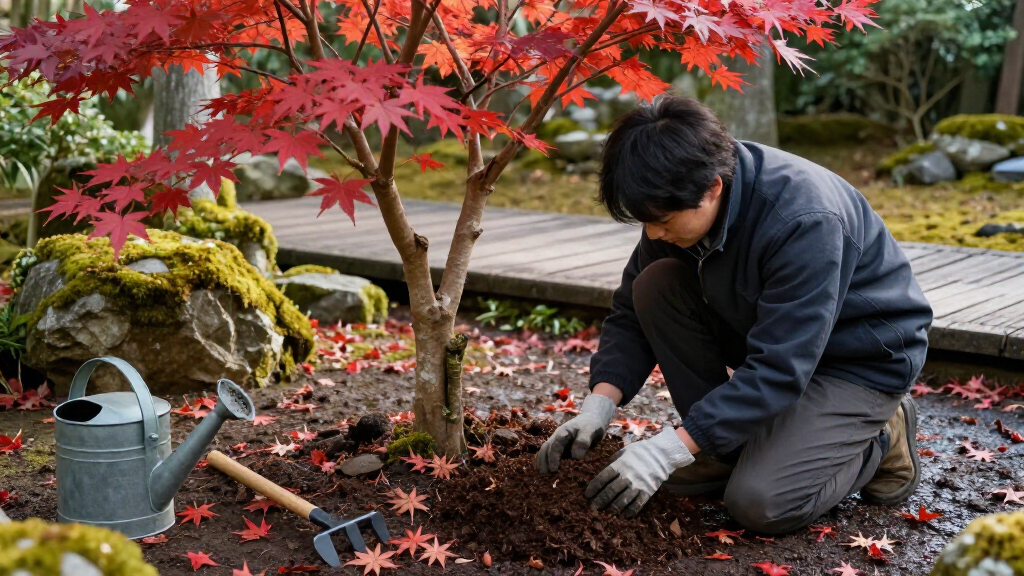
For root protection, Breglia recommends adding organic material such as shredded bark or wood chips, or replenishing an existing mulch layer. A layer about 2 to 4 inches deep can insulate shallow roots against early freezes, according to his advice. Mulch should not touch the trunk, where retained moisture may contribute to decay or pest problems. The report also suggests wrapping containers or moving potted maples to a sheltered location because their roots are more exposed to cold.
The third task is reducing the risk of winter sunscald, which can damage bark when winter sunshine warms dormant trunk tissue that is then exposed to freezing temperatures. Breglia recommends a ventilated tree wrap or other breathable material that fits around the trunk without trapping moisture. A mesh tree guard can also help keep deer, rabbits and rodents from browsing bark when other food is scarce. The report advises reducing watering as leaves fall and avoiding waterlogged soil.
Protecting Roots and Trunks Before Frost
These tasks address different forms of winter stress: branch damage, freezing around shallow roots and injury to trunk bark. Young trees may be more vulnerable, while potted maples have less insulation around their roots than trees planted in the ground. Completing basic checks before colder weather arrives can help gardeners identify broken limbs and put protective materials in place in time.
The advice also stresses that protection should not create new problems. Mulch piled against a trunk can hold moisture, while a wrap that traps moisture may harm bark. The report’s guidance is to use breathable protection and keep mulch clear of the trunk, rather than applying materials indiscriminately.
bypass pruning shears for Japanese maple branches
As an affiliate, we earn on qualifying purchases.
As an affiliate, we earn on qualifying purchases.
The Arborist’s October Checklist
The report, published by Homes & Gardens, frames October as a period for targeted preparation rather than extensive pruning. Japanese maples, also called acers, are often grown for their fall color, and established trees generally need relatively little routine care. The article’s focus is on tasks that can address damage and winter exposure before the coldest part of the year.
Breglia is identified in the report as the executive director of Landis Arboretum in New York and an ISA-certified arborist with more than 35 years of experience in the green industry. His recommendations distinguish between removing damaged branches and undertaking major shaping: the former may be done as a cleanup task, while the report cautions against poorly timed heavy pruning.
“Remove dead, diseased, or broken branches so problems are less likely to spread into healthy parts of the tree.”
— Fred Breglia, ISA-certified arborist, quoted by Homes & Gardens
shredded bark mulch for trees 2 to 4 inch layer
As an affiliate, we earn on qualifying purchases.
As an affiliate, we earn on qualifying purchases.
How Conditions Change the Advice
The report does not specify a single date that will suit every region or climate. Local temperatures, site exposure, tree age and whether a maple is planted in the ground or a container can affect when protection is needed. It also does not provide a pruning plan for individual trees or quantify how much each task reduces winter injury.
Readers should treat the checklist as general guidance attributed to Breglia, not a diagnosis of a particular tree. The report does not address unusual cases such as extensive disease, major structural damage or severe root problems; those may require advice from a qualified local arborist.
breathable tree trunk wrap for winter sunscald
As an affiliate, we earn on qualifying purchases.
As an affiliate, we earn on qualifying purchases.
Complete Checks Before Winter
Gardeners following the report can inspect their maples for dead or broken limbs, apply or refresh mulch while leaving a gap around the trunk, and assess whether young trees need breathable trunk protection or a mesh guard. Owners of potted maples can consider insulating the container or moving it to a sheltered position. As leaves fall, the report advises adjusting watering to avoid waterlogged soil.
The recommendations are seasonal rather than tied to a stated follow-up date. The next practical step is to monitor local weather and the condition of each tree, while seeking an arborist’s assessment if damage or disease goes beyond routine maintenance.
mesh tree guard to protect young trees from deer rabbits
As an affiliate, we earn on qualifying purchases.
As an affiliate, we earn on qualifying purchases.
Key Questions
What should I do for a Japanese maple before the end of October?
The Homes & Gardens report recommends removing dead, diseased or broken branches, mulching around roots and protecting the trunk from sunscald or animal browsing.
How deep should mulch be around a Japanese maple?
Arborist Fred Breglia recommends an organic mulch layer about 2 to 4 inches deep. Keep it away from the trunk to reduce the risk of decay and pest problems.
Should I prune a Japanese maple heavily in October?
The report advises limiting October pruning to essential cuts for dead, diseased or broken branches. Breglia cautions against major pruning at unsuitable times, including late summer and early fall.
How can I protect a Japanese maple from winter sunscald?
Breglia recommends a ventilated tree wrap or breathable protective material fitted around the trunk without trapping moisture. A mesh guard may also deter animals from browsing bark.
Source: rss
Halloween Picks
halloween
As an affiliate, we earn on qualifying purchases.