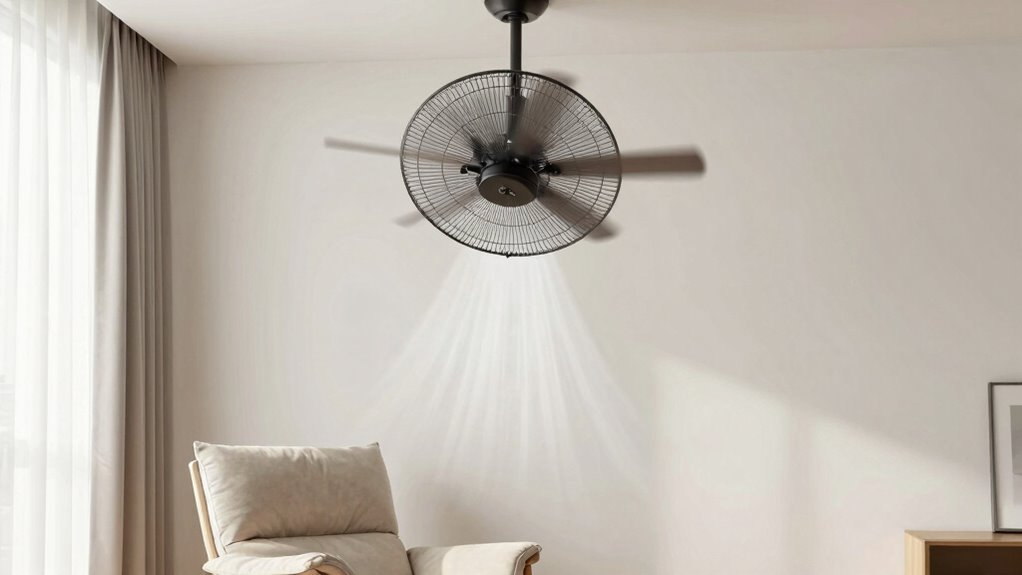

Proper fan placement is more important than just choosing a powerful fan because it directly influences airflow and cooling efficiency. When you position a fan strategically—focusing on airflow patterns, avoiding obstructions, and encouraging air exchange—you’ll experience better comfort without increasing energy use. Good placement can create effective circulation, push hot air out, and prevent stagnant zones. Want to discover how to optimize your fan setup even further? Keep exploring to learn more.
Key Takeaways
- Proper placement improves airflow and cooling efficiency more than increasing fan wattage.
- Strategic positioning creates effective air exchange, enhancing comfort without higher power.
- Good fan placement prevents stagnant air and dead zones, optimizing circulation.
- Understanding room layout helps position fans for better cross-breezes and airflow patterns.
- Effective placement reduces energy use and boosts cooling performance compared to simply using stronger fans.
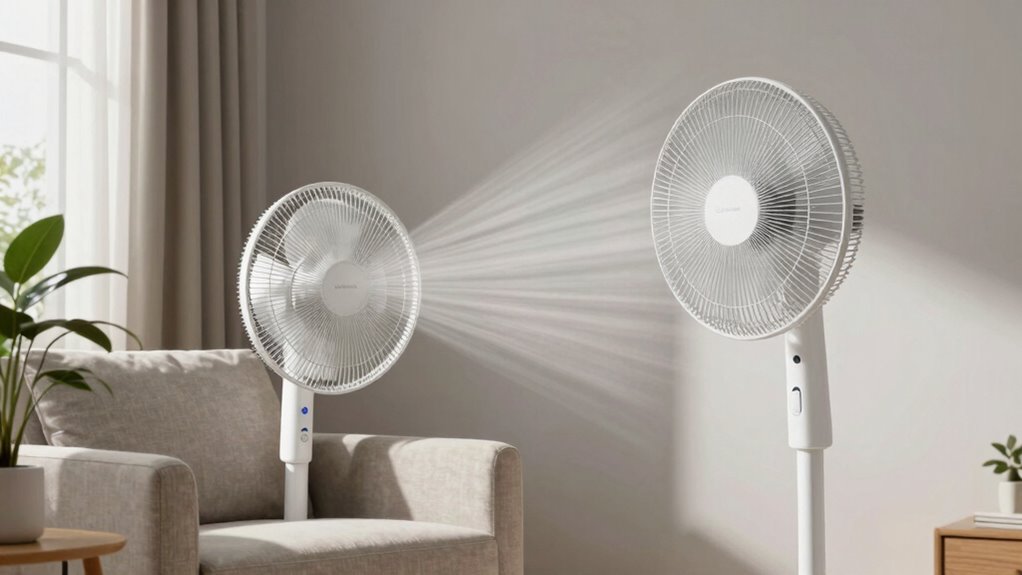
When it comes to improving airflow and cooling efficiency, where you place your fans matters more than how powerful they are. Proper fan placement can considerably enhance airflow optimization, making your space cooler and more comfortable without necessarily investing in high-wattage units. The key lies in understanding how room airflow works and positioning your fans to facilitate a steady exchange of air. A strategically placed fan can create a cross-breeze, pull in fresh air from one side, and push stale air out the other, leading to a more consistent and effective cooling process.
Strategic fan placement boosts airflow and cooling efficiency more than just power alone.
You should start by identifying the natural flow of air in your room. For example, if you notice that warm air rises and collects near the ceiling, placing a fan near the floor to blow air upward can help circulate cooler air throughout the space. Conversely, if hot air tends to gather near windows or vents, positioning a fan to push air out of the room can accelerate heat removal and improve overall room airflow. The goal is to establish a continuous loop, where fresh air enters, circulates, and exits efficiently. Understanding airflow dynamics can help you better predict how air moves within your space and improve your fan placement strategy.
Another vital aspect is avoiding dead zones—areas where airflow stagnates. If your fan is positioned poorly, it might only circulate air in one small corner while the rest of the room remains stagnant. To prevent this, experiment with different placements, ensuring the air movement covers the entire room rather than just a localized spot. Sometimes, placing fans perpendicular to each other creates a more dynamic and effective airflow pattern, improving overall room airflow and cooling performance. Proper fan placement is essential to maximize circulation and avoid inefficient airflow patterns. Additionally, considering the room layout and furniture arrangement can help optimize airflow paths and prevent obstructions. A good understanding of airflow patterns can significantly influence how effectively your fans work.
Remember, the placement of fans also depends on your room’s layout and furniture placement. Large objects or walls can obstruct airflow, so keep fans away from corners or behind furniture that blocks air movement. Elevating fans to a higher position can also promote better circulation, especially in rooms with high ceilings. Fundamentally, focusing on airflow optimization through strategic placement ensures that your fans work smarter, not necessarily stronger. Additionally, understanding airflow dynamics can help you better predict how air moves within your space and improve your fan placement strategy. Properly positioning fans to enhance air circulation can make a noticeable difference in cooling performance.
Ultimately, you’ll find that a well-placed fan can outperform a more powerful one that’s poorly positioned. By paying close attention to how airflow moves within your space, you can maximize cooling efficiency, reduce energy consumption, and create a more comfortable environment. The right placement transforms simple fans into effective tools for managing room airflow, proving that where you put your fans is just as important as how powerful they are.

Levoit Standing Fan for Bedroom, 90° Oscillating Fan, 20dB Quiet for Sleep
- Powerful Air Circulation: Up to 22ft/s wind speed, 1024CFM airflow
- Quiet Operation: Operates at just 20dB for sleep
- Wide-Angle Cooling: 90° oscillation with vertical adjustment
As an affiliate, we earn on qualifying purchases.
As an affiliate, we earn on qualifying purchases.
Frequently Asked Questions
How Does Room Size Affect Fan Placement Choices?
Room size directly influences your fan placement choices for best airflow and cooling efficiency. In larger rooms, position fans near entry points or windows to promote airflow throughout the space, preventing hot spots. In smaller rooms, place fans centrally or near heat sources to maximize airflow and temperature reduction. Proper placement ensures airflow enhancement, helping your fan work more effectively, whether in a compact space or a spacious area.
What Are Common Mistakes in Fan Positioning?
You often make mistakes in fan positioning by not adjusting fan oscillation or ceiling fan direction properly. For example, neglecting to turn off oscillation can cause uneven airflow, while setting the ceiling fan direction incorrectly—like summer mode instead of winter—reduces efficiency. Always guarantee your fan oscillates to cover the room evenly and switch the ceiling fan direction seasonally for maximum comfort and energy savings.
Can Strategic Placement Reduce the Need for Powerful Fans?
Yes, strategic placement can reduce the need for powerful fans by optimizing airflow patterns. By carefully adjusting fan orientation, you direct air where it’s needed most, creating efficient circulation. Proper placement guarantees that cool or warm air moves effectively throughout the space, minimizing dead zones. This approach lets you achieve desired airflow with less power, saving energy and reducing noise, all while maintaining a comfortable environment.
How Does Furniture Placement Influence Fan Effectiveness?
You’ll find that furniture placement greatly influences fan effectiveness because furniture interference and airflow obstruction can block the breeze. When you position furniture thoughtfully, you allow airflow to circulate freely, maximizing cooling. Avoid placing large pieces directly in front of fans or blocking vents. Instead, keep pathways clear and angle fans toward open spaces. This way, you enhance airflow, making even moderate fans work harder and more efficiently in cooling your space.
Are There Specific Placements for Optimal Airflow in Different Rooms?
You should position your ceiling fan at the ideal height, ideally about 8-9 feet from the floor, to maximize airflow. In rooms with windows, place the fan to complement window positioning—such as away from direct sunlight or drafts—to enhance circulation. Adjust the fan’s direction seasonally: downward in summer for cooling and upward in winter for warmth. Proper placement guarantees efficient airflow regardless of room size or layout.
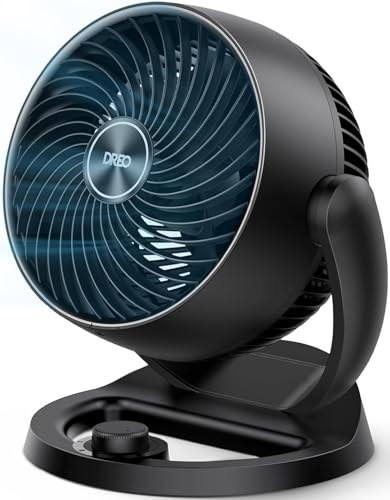
DREO Fan for Bedroom, 12 Inches, 70ft Powerful Airflow, 25db Quiet Table Air Circulator Fans for Whole Room, 120° Adjustable Tilt, 3 Speeds, Desktop Fan for Home, Office, Kitchen
- Powerful airflow for entire room: Circulates air up to 70 ft
- Quiet operation at 25dB: Enjoy wind without noise
- Energy-saving design: Enhances efficiency of other appliances
As an affiliate, we earn on qualifying purchases.
As an affiliate, we earn on qualifying purchases.
Conclusion
Remember, placing your fans wisely is like guiding a gentle river to flow where you want it, rather than just relying on its strength. Even the mightiest fan can’t do much if it’s blowing in the wrong direction. Focus on strategic placement to facilitate better airflow, cooling efficiency, and comfort. When you position your fans thoughtfully, you’re not just moving air—you’re directing it like a skilled conductor leading a symphony of freshness.

BEYOND BREEZE Oscillating Table Fan for Bedroom, 12-Inch & 3 Speeds, White
- Powerful and Quiet Cooling: 3-speed adjustable oscillating fan
- Silent Operation: Virtually silent motor for quiet use
- Safe and Durable Design: Metal grill for safety and protection
As an affiliate, we earn on qualifying purchases.
As an affiliate, we earn on qualifying purchases.

Lasko Cyclone Oscillating Pedestal Fan – Adjustable to 54" – 1843 – Black
- Powerful, Quiet Cooling: Three speeds with widespread oscillation
- Adjustable Height: Extends up to 54 inches with tilt head
- Remote Control Convenience: Adjusts settings and timer remotely
As an affiliate, we earn on qualifying purchases.
As an affiliate, we earn on qualifying purchases.